



On November 19, 2025, Adobe announced a definitive agreement to acquire Semrush, the leading online visibility management SaaS platform, for approximately $1.9 billion in an all-cash transaction. Valued at $12.00 per share, this deal is expected to close in the first half of 2026.
For the casual observer, this looks like another tech giant absorbing a popular tool. But for CMOs, SEO directors, and digital strategists, this is a seismic shift. Adobe isn’t just buying a keyword research tool; they are buying the infrastructure for the next era of the internet: Generative Engine Optimization (GEO).
As we move from an era of “Ten Blue Links” to an era of Agentic AI – where autonomous agents perform tasks and answer questions on behalf of users – the old rules of SEO are being rewritten. The Adobe-Semrush merger is the first major signal that “Visibility” is no longer about ranking; it is about being the fundamental data source for AI.
In this deep dive, we will analyze why this deal happened, what it means for your marketing stack, and provide a 5-step roadmap to future-proof your strategy for 2026.
Introduction: The Deal That Broke the Marketing Silos
For the last 15 years, the digital marketing services workflow has been fragmented.
- Ideation & Data: You went to Semrush to find what people were searching for.
- Creation: You went to Adobe Creative Cloud to build the assets.
- Delivery: You used a CMS (like Adobe Experience Manager) to publish.
- Measurement: You went back to Semrush or Analytics to see if it ranked.
This disconnected loop created a massive inefficiency: Creators were blind to data, and SEOs were disconnected from creation.
With this acquisition, Adobe is effectively closing the loop. By integrating Semrush’s massive data lake – containing over 25 billion keywords and 43 trillion backlinks – directly into the Adobe ecosystem, they are creating a “Content Supply Chain” that is data-informed from the very first pixel.
But the implications go far beyond workflow efficiency. This acquisition is a defensive and offensive move against the disruption of AI Search. As users migrate from Google Search to AI interfaces like ChatGPT, Claude, and Gemini, the “click” is dying. Adobe knows that in a world without clicks, the only currency left is Data Integrity and Brand Visibility.
The Strategic “Why”: Completing the Content Supply Chain
Why would the company behind Photoshop spend nearly $2 billion on an SEO suite? To understand the valuation, you have to understand Adobe’s “Content Supply Chain” strategy.
Bridging the Gap Between “Make” and “Find”
Adobe has mastered the art of helping brands make content (Photoshop, Premiere, Firefly) and deliver content (Experience Cloud). However, they have historically had a massive blind spot: Discovery.
Adobe had no native way of telling a creative director, “You should design this infographic because 50,000 people are searching for this specific answer right now.”
With Semrush, Adobe gains the “eyes” of the internet. They can now inject “Search Intent” data directly into the creative process. Imagine a future version of Adobe Firefly (Adobe’s Generative AI model) that doesn’t just generate an image based on your prompt, but auto-suggests alt-text and file names based on high-value keyword opportunities identified by Semrush.
From “Vanity Metrics” to “Revenue Visibility”
One of the biggest pain points for enterprise SEOs is proving ROI. SEO data often sits in a silo, separated from the actual revenue data in the CRM or ERP.
By folding Semrush into Adobe Analytics and Customer Journey Analytics, Adobe can finally solve the attribution nightmare. Marketers will potentially be able to see a direct line from a specific keyword ranking to a closed deal in Adobe Commerce, without the messy data patching required today.
Expert Insight: “This isn’t about keywords. It’s about ‘Information Gain.’ Adobe wants to own the system that tells brands not just how to create content, but what to create to ensure maximum visibility in an AI-first world.”
The Paradigm Shift: SEO vs. GEO (Generative Engine Optimization)
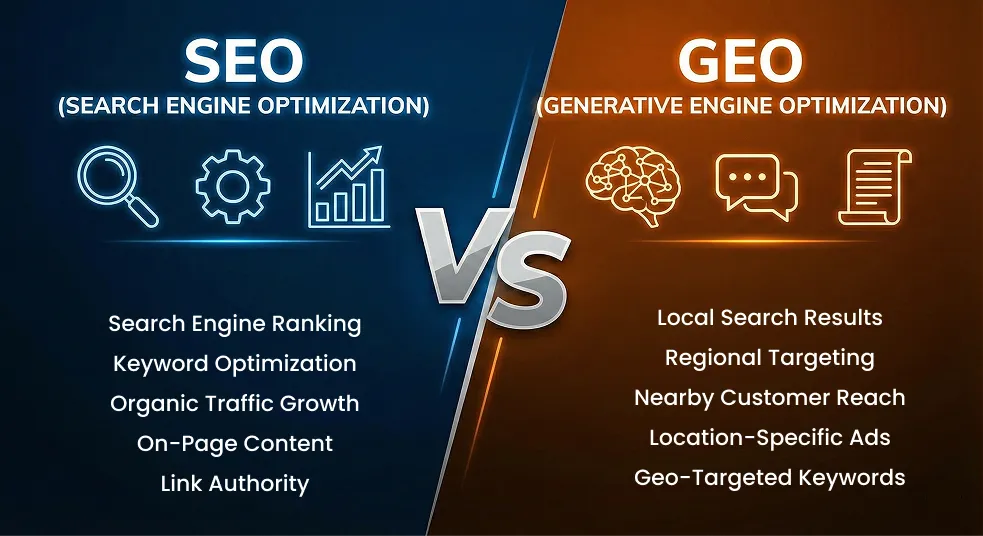
The most critical buzzword to emerge from this acquisition is GEO (Generative Engine Optimization). If you take nothing else from this article, understand this: SEO is for Search Engines; GEO is for Answer Engines.
We are transitioning from a world where users search for a list of links (Google) to a world where users ask for a direct answer (ChatGPT/Gemini). In this new environment, your goal is not to rank #1; your goal is to be the cited source that the AI uses to construct its answer.
Defining GEO in the Age of Answer Engines
Generative Engine Optimization (GEO) is the practice of optimizing content to be easily read, understood, and trusted by Large Language Models (LLMs). Unlike traditional SEO, which relies heavily on backlinks and keyword density, GEO relies on:
- Authority & Trust: Does the AI model view this brand as a factual entity?
- Structure: Is the data formatted so a machine can parse it (JSON-LD, Tables)?
- Context: Does the content provide unique value (“Information Gain”) that isn’t found elsewhere?
SEO vs. GEO: The Core Differences
| Feature | Traditional SEO (2010–2024) | Generative Engine Optimization (2025+) |
|---|---|---|
| Primary Target | Google Spider (Bot) | LLM (AI Model) & Agents |
| User Intent | Finding a Website | Getting an Answer / Task Completion |
| Key Metric | Click-Through Rate (CTR) | Share of Model (SoM) / Citation Rate |
| Content Structure | Long-form, Keyword-rich | Concise, Fact-dense, Structured Data |
| Success Look | Ranking #1 on Page 1 | Being the “Source” link in an AI summary |
| Technical Focus | Core Web Vitals, Hreflang | Knowledge Graph, Entity Optimization |
The Adobe-Semrush deal is a bet on the right column. Adobe knows that as traffic to websites decreases (due to zero-click AI answers), brands will need new tools to measure their visibility in the “black box” of AI models. Semrush has already begun building these tools (like “Share of Model” metrics), and Adobe will scale them to the enterprise.
The Rise of Agentic AI: Why “Structured Data” is the New King
The buzz around “Agentic AI” was front and center in Adobe’s press release. But what does Agentic Marketing actually mean for an SEO strategist?
Marketing to Machines, Not Humans
In 2026, a significant portion of your “traffic” will not be human. It will be AI Agents.
- Human Search: “Best running shoes for marathons.”
- Agentic Task: “Find the top-rated marathon shoe under $150 in size 10 that can be delivered by Friday, and buy it.”
In the second scenario, the AI agent does not care about your emotional brand storytelling or your hero banner image. It cares about Data Confidence. It needs to know – with 100% certainty that your product is in stock, is the price you say it is, and has the rating you claim.
If your site is not optimized with perfect Schema markup and structured data, the AI agent will simply ignore you.
The “Zero-Click” Reality
This leads to the uncomfortable reality of the future: Zero-Click Search. As AI agents handle more tasks, fewer humans will visit your actual website.
This terrifies marketers who rely on ad revenue or traffic metrics. However, for B2B and e-commerce brands, this is an opportunity. If Adobe and Semrush can provide the analytics to prove that an AI agent read your content and then made a purchase decision, “Traffic” becomes a vanity metric. The focus shifts entirely to Entity Authority – ensuring your brand is the “trusted node” in the AI’s knowledge graph.
What This Means for Your Stack: Adobe Experience Cloud Integration
For current users of Adobe and Semrush, the immediate question is practical: What happens to my tools?
The Future of Adobe Experience Manager (AEM)
Expect Adobe Experience Manager (AEM) to become the first “GEO-Native” CMS. We predict the following integrations within the next 18 months:
- The “SEO Sidebar”: As you type content in AEM, a Semrush-powered sidebar will likely score your content not just for readability, but for “LLM Legibility” – predicting how well ChatGPT will understand your text.
- Auto-Schema Injection: AEM will likely use Semrush’s entity data to automatically apply complex JSON-LD schema to your pages without developers needing to code.
- Content Gap AI: Adobe GenStudio will likely be able to scan your competitors (using Semrush data) and automatically suggest – or even draft – pages that are missing from your site to close the visibility gap.
Will Semrush Disappear? (The Platform Risk)
If history is a guide (look at Adobe’s acquisition of Marketo or Magento), Semrush will not disappear, but it will change.
- For SMBs: Semrush will likely remain a standalone product for some time, though prices may creep up as “Enterprise features” get gated.
- For Enterprise: Semrush will likely be rebranded as “Adobe Marketing Data Cloud” or similar, and bundled with the Experience Cloud.
- The Risk: The biggest risk for SEOs is the “Walled Garden.” If the best GEO data becomes exclusive to the Adobe ecosystem, brands using WordPress, Shopify, or other CMS platforms may find themselves at a data disadvantage.
Actionable Strategy: 5 Steps to Future-Proof Your SEO for 2026
You don’t need to wait for the acquisition to close to adapt. The shift to GEO and Agentic AI is happening now. Here is your 5-step roadmap to survive the transition.
1. Audit Your “Brand Entity”
Stop checking your keyword rankings for a moment. Go to ChatGPT, Claude, and Gemini and ask: “What is [My Brand], and what are they best known for?”
- The Goal: The AI should give a precise, accurate description of your USP.
- The Fix: If the AI hallucinates or gives a vague answer, your “Digital PR” is failing. You need to secure mentions on high-authority, trusted publications (Wikidata, Crunchbase, major industry news) to “teach” the Knowledge Graph who you are.
2. Optimize for “Information Gain”
LLMs are trained to predict the next word. They thrive on patterns, but they value novelty. If your blog post is just a rehash of the top 3 Google results, AI models view it as “low entropy” (low value) and will likely ignore it.
- The Strategy: Every piece of content you publish must have Information Gain. This means adding original data, proprietary research, expert quotes, or a contrarian viewpoint that does not exist elsewhere on the web.
3. Double Down on Technical Schema
To win with Agentic AI, you must speak its language. That language is Schema.org.
- Action: Go beyond the basics. Implement nested schema. Connect your Organization schema to your Product schema. Use Same As tags to link your social profiles. Use Speakable schema for voice assistants. You are essentially building an API for your brand that AI agents can query.
4. Diversify Beyond Google
Adobe knows Google’s monopoly is cracking. The “Search” of 2026 will be fragmented across Google, TikTok, Perplexity, Amazon (for products), and vertical-specific AIs.
- Action: Start tracking your visibility on Perplexity and Bing (which powers ChatGPT). Ensure your video content is optimized for TikTok SEO, as this is the primary search engine for Gen Z.
5. Align Content & Creative Teams
The Adobe-Semrush deal proves that data and creativity can no longer be separate.
- Action: Force your SEO team and your Creative team to sit in the same room (or Zoom). Your designers need to understand search intent so they create visuals that answer user questions. Your SEOs need to understand brand voice so they don’t optimize for traffic that kills brand equity.
Conclusion
The Adobe-Semrush acquisition is more than a corporate transaction; it is a definitive validation that Search is evolving into a faster, more complex ecosystem. As we transition into the era of the ‘Visibility Cloud,’ strategic partners like Vizz Web Solutions recognize that success is no longer measured solely by website visits. Instead, true digital dominance is now defined by how often your brand is cited, trusted, and recommended by the AI models that run the world.
For the savvy marketer, this is not a threat; it is an invitation to upgrade. The tools are changing, the metrics are changing, but the core mission remains the same: To be the best answer to your customer’s question.
Frequently Asked Questions
Q1: When will the deal officially close?
The deal is expected to close in the first half of 2026, pending regulatory approvals. Until then, both companies will continue to operate independently.
Q2: Will Semrush become free for Creative Cloud users?
Highly unlikely. Adobe typically integrates acquisitions as premium add-ons or tiers within the Experience Cloud. We expect Semrush data to be a paid “power-up” for enterprise users.
Q3: Is “Old SEO” dead?
“Ten Blue Links” SEO is declining, but it won’t die overnight. However, “Keyword Stuffing” and “SEO-for-robots” are dead. The future is Entity Optimization – proving your expertise so both humans and machines trust you.
Q4: What is the biggest risk of this merger?
The consolidation of data. With Adobe owning the creative, the analytics, and now the search data, they will have unprecedented power over the digital marketing landscape. This could lead to higher costs for marketers and a higher barrier to entry for smaller competitors.