


Artificial intelligence is entering a new phase. Businesses have traditionally used AI to generate content, answer questions, analyze data, make recommendations, and support employees. Now, Agentic AI and Autonomous Agents can go further by reasoning about goals, creating plans, using software tools, making decisions, and completing multi-step tasks with limited human intervention. This is changing AI from a tool that simply responds to instructions into a digital workforce that can actively move business processes forward.
For example, an AI agent in real estate can search property databases, compare listings, qualify leads, schedule viewings, update a CRM, and prepare follow-ups. In restaurants, agents can manage reservations and customer requests, while manufacturing businesses can use them to monitor operations and identify potential issues. In logistics, AI agents can track shipments, detect delays, communicate updates, and help coordinate corrective actions. This is why Agentic AI development is becoming increasingly important for modern businesses. As AI continues to evolve, the focus is shifting from simply using AI to identifying which business processes can be intelligently automated.
For businesses planning their next stage of digital transformation, the important question is no longer just, “Can we use AI?” It is “Which tasks and workflows should our AI agents be able to handle?”
What Is Agentic AI?
Agentic AI is artificial intelligence designed to pursue goals, make decisions, and take actions to complete tasks. Unlike traditional AI that responds to requests, an AI agent can determine what needs to happen next, select the right tools, take action, evaluate results, and continue toward a defined goal. AI agents combine models with tools, instructions, and guardrails to interact with business systems, databases, APIs, and other software. This allows them to execute multi-step workflows rather than simply generate information. Not every chatbot is an AI agent. A chatbot mainly answers questions, while an AI agent can make decisions, interact with external systems, and take actions to complete a workflow.
What Are Autonomous AI Agents?
Autonomous AI agents are software systems that can perform tasks independently within defined instructions, permissions, and boundaries. They can gather information, make decisions, use connected tools, and complete tasks without constant human guidance. However, autonomy does not mean unlimited control. Businesses should use controlled autonomy, such as allowing a logistics agent to track shipments, communicate with carriers, and suggest alternative routes while requiring human approval for high-value or sensitive decisions. The goal is not complete independence, but giving AI agents the right level of autonomy for each business task while maintaining human oversight.
How Do AI Agents Work?
A modern AI agent generally operates through a continuous reasoning and action process. First, the agent receives a goal or trigger. It then gathers relevant information, interprets the situation, develops a plan, selects the tools it needs, performs actions, checks the results, and determines what should happen next. For example:
Goal: Reduce customer complaints about delayed restaurant deliveries.
The agent might:
- Review current delivery orders.
- Identify delayed orders.
- Check delivery status.
- Determine the likely cause.
- Contact the delivery system or restaurant workflow.
- Notify the customer.
- Offer an approved resolution.
- Update the order record.
- Escalate unusual cases to a human.
- Monitor the outcome.
The important difference is that the agent is not merely generating a message. It is participating in the workflow. Google Cloud describes agentic workflows as dynamic processes in which agents use reasoning, planning, and external tools to execute complex multi-step tasks and adjust their actions according to the runtime environment.
What Are the Main Components of an Autonomous AI Agent?
A production-ready AI agent usually needs several components working together.
- AI Model: The underlying language or reasoning model interprets instructions, evaluates information, and helps determine the next action.
- Tools and APIs: Tools give the agent the ability to interact with the real world of business software. These may include CRM systems, ERP platforms, databases, payment systems, inventory platforms, calendars, email, search systems, internal applications, and third-party APIs.
- Memory and Context: Agents may need information about previous interactions, business rules, customer information, active tasks, or previous steps in a workflow.
- Orchestration: Orchestration determines how agents, tools, workflows, and specialized systems work together. More advanced businesses may use multiple specialized agents rather than one general-purpose agent.
- Guardrails and Permissions: An agent should know what it can and cannot do. Permissions, approval thresholds, access controls, validation rules, and escalation paths are critical.
- Monitoring and Evaluation: Businesses need to know what an agent did, why it took an action, whether the action was successful, and where failures occurred.
Modern agent development is therefore much more than connecting a chatbot to an API. It is a combination of AI engineering, software development, workflow design, data architecture, security, and business process optimization.
Why Are Agentic AI and Autonomous Agents Important for Businesses?
Businesses need to respond faster, reduce operating costs, and deliver better customer experiences. Yet employees still spend considerable time on repetitive tasks such as checking information, updating systems, following up with customers, preparing reports, scheduling appointments, and monitoring operations. Agentic AI can automate many of these workflows by gathering information, evaluating options, taking approved actions, and escalating exceptions to employees when needed.
The traditional workflow often looks like:
Human finds information → Human makes a decision → Human takes action
With AI agents, it can become:
Agent gathers information → Agent evaluates options → Agent takes approved action → Human handles exceptions
This does not mean replacing employees. Instead, AI agents can handle repetitive operational work while people focus on strategy, creativity, customer relationships, negotiations, and complex decisions. The shift is from AI as a tool to AI as an operational layer, where intelligent agents become part of everyday business processes and help organizations work faster and at greater scale.
Agentic AI Use Cases Across Industries
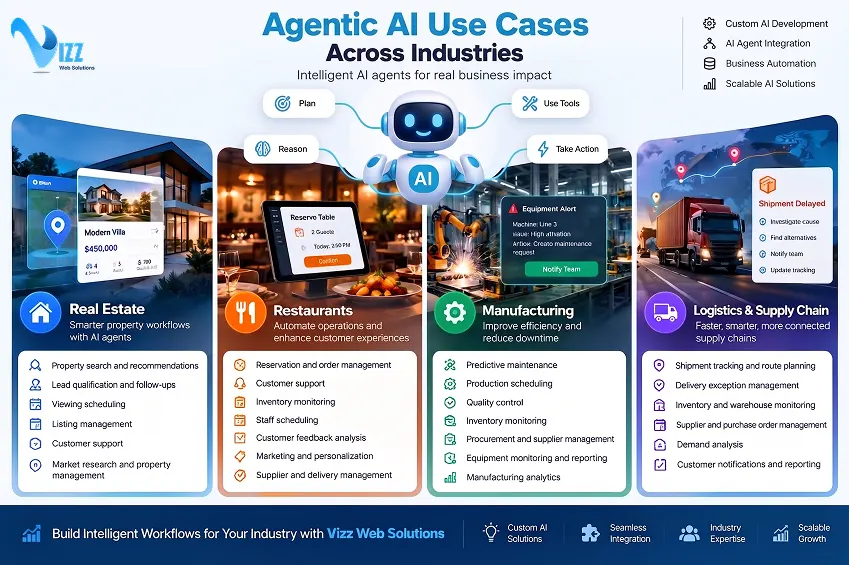
Agentic AI can potentially be applied to almost any business with structured processes, accessible data, and software systems. However, some industries have especially strong opportunities.
1. Agentic AI for Real Estate
Real estate involves property data, leads, customer communication, scheduling, and follow-ups. An AI agent can connect with CRMs, property databases, listing platforms, email, and calendars to automate these workflows. For example, an agent can search properties based on a buyer’s budget and requirements, compare listings, create a shortlist, schedule viewings, send reminders, update the CRM, and follow up with leads.
Common applications include:
- Property search and recommendations
- Lead qualification and follow-ups
- Viewing scheduling
- Listing management
- Customer support
- Market research and property management
Multiple agents can also work together, creating a connected digital real estate workflow that goes beyond a traditional chatbot.
2. Agentic AI for Restaurants
Restaurants manage reservations, orders, customer questions, inventory, staff schedules, suppliers, and deliveries. An AI agent can connect with reservation systems, POS platforms, inventory software, websites, and customer databases to automate these real-time workflows. For example, an agent can check table availability, confirm reservations, send reminders, monitor inventory, assist with orders, and analyze customer feedback.
Common applications include:
- Reservation and order management
- Customer support
- Inventory monitoring
- Staff scheduling
- Customer feedback analysis
- Marketing and personalization
- Supplier and delivery management
By automating repetitive tasks, Agentic AI for restaurants allows staff to focus more on customers and daily operations.
3. Agentic AI for Manufacturing
Manufacturing involves equipment, production schedules, inventory, quality control, maintenance, and supply chains. AI agents can connect these systems and help teams respond to operational issues faster. For example, an agent can detect a potential equipment problem, review maintenance history, check available parts, create a maintenance request, notify the right team, and track the issue.
Common applications include:
- Predictive maintenance
- Production scheduling
- Quality control
- Inventory monitoring
- Procurement and supplier management
- Equipment monitoring and reporting
- Manufacturing analytics
By connecting multiple steps, Agentic AI can reduce manual coordination and make manufacturing workflows more efficient.
4. Agentic AI for Logistics and Supply Chain
Logistics and supply chains constantly change due to shipment delays, inventory fluctuations, changing costs, and customer demands. AI agents can monitor these conditions and respond according to predefined business rules. For example, an agent can detect a shipment delay, investigate the cause, identify alternatives, estimate the impact, notify relevant teams, update tracking information, and escalate decisions requiring human approval.
Common applications include:
- Shipment tracking and route planning
- Delivery exception management
- Inventory and warehouse monitoring
- Supplier and purchase order management
- Demand analysis
- Customer notifications and reporting
By combining data, reasoning, communication, and action, Agentic AI can help create faster and more connected logistics workflows.
Agentic AI vs Automation: What Is the Difference?
Businesses often ask whether they need AI agents when traditional automation can already handle many tasks. The answer depends on the type of workflow. Traditional automation works best for predictable, rule-based tasks, such as automatically sending a confirmation and updating the CRM after a payment is received.
AI agents are more useful for workflows involving changing conditions, multiple steps, and decision-making. For example, an agent can investigate a delayed order, check relevant systems, identify possible solutions, communicate with the customer, and escalate complex issues when human approval is required.
Agentic AI does not replace traditional automation. Instead, businesses can combine AI agents, APIs, databases, and automation to create smarter workflows that adapt to changing situations while keeping humans involved when needed.
Benefits of Agentic AI for Businesses
The business value of autonomous AI agents can come from several areas.
- Greater Productivity: Agents can handle repetitive, multi-step processes and allow employees to concentrate on higher-value activities.
- Faster Operations: An agent can operate continuously and respond to events without waiting for an employee to become available.
- Better Customer Experiences: AI agents can provide immediate responses and perform actions instead of simply directing customers to another department.
- Scalable Operations: A well-designed digital workflow can potentially process significantly more tasks without requiring a proportional increase in manual effort.
- Better Use of Business Data: Agents can connect information across systems and use it in context rather than leaving data isolated in separate applications.
- Consistent Processes: When properly designed, agents can follow business policies, workflows, and escalation rules consistently.
AWS reports that businesses are increasingly redesigning workflows around agents rather than treating AI as an isolated tool, highlighting the importance of workflow-level transformation.
Why Businesses Should Start Preparing for Agentic AI Now
AI is moving from experimentation toward practical business use, with companies increasingly exploring Agentic AI to automate and improve everyday operations. Businesses do not need hundreds of AI agents today. Instead, they should identify the workflows where agents can provide real value. The focus should be on choosing the right processes, connecting reliable data and systems, setting appropriate permissions, and continuously measuring performance. Preparing now can help businesses build a stronger foundation for increasingly intelligent automation.
How to Build an Agentic AI System for Your Business
Building an autonomous AI agent should start with a business problem, not just an AI model. At Vizz Web Solutions, our processes focus on identifying repetitive, data-driven, or time-sensitive workflows that can benefit from intelligent automation. Key development stages include:
- Requirement Analysis:Define business goals, workflows, systems, data, and required level of autonomy.
- Data Preparation:Collect, organize, and secure the information the agent needs.
- Agent Development:Build the agent’s logic, instructions, tools, memory, and decision-making capabilities.
- System Integration:Connect the agent with CRMs, databases, ERP systems, websites, calendars, inventory platforms, and APIs.
- Testing:Test workflows, edge cases, security, failures, and human escalation.
- Deployment:Launch the agent with appropriate permissions, monitoring, and controls.
- Continuous Improvement:Monitor performance, identify issues, and optimize the agent as business needs evolve.
A reliable Agentic AI system requires more than a working prototype. Testing, monitoring, guardrails, security, and ongoing optimization are essential for successful business deployment.
Build Custom Agentic AI and Autonomous Agents With Vizz Web Solutions
Off-the-shelf AI tools are useful for testing ideas, but businesses often need AI that understands their specific workflows, data, systems, and customers. Vizz Web Solutions provides custom AI development for businesses looking to build Agentic AI and Autonomous Agents tailored to their needs. With 14+ years of software development experience and 1,200+ services delivered, Vizz provides AI, automation, web, mobile, SaaS, and enterprise software solutions.
Our expert teams at Vizz Web can help with:
- AI chatbots and virtual assistants
- AI product development and automation
- Predictive analytics and NLP
- AI security and intelligent web solutions
- Agent design, integration, testing, and deployment
Our AI development teams also work with technologies including React, Angular, Vue.js, Node.js, Laravel, MongoDB, MySQL, Elasticsearch, AWS RDS, and AWS Redshift. Whether you need a real estate AI assistant, restaurant automation agent, manufacturing solution, or logistics agent, the process starts by identifying a real business problem and designing an intelligent workflow around it.
The future of AI is not only about generating answers. It is about getting work done. Businesses ready to move from AI experimentation to intelligent automation can work with us to build scalable Agentic AI solutions for their operations.
The Future of Agentic AI and Autonomous Agents
The future of AI is moving beyond simple question-and-answer interactions toward intelligent agents embedded in business systems. AI agents will increasingly handle repetitive, multi-step tasks across sales, operations, customer service, logistics, finance, and analytics, while people focus on strategy, creativity, and important decisions. As autonomous agents become integrated with business software and workflows, they could become as important to digital operations as cloud computing and automation. Businesses that prepare for Agentic AI now can build more intelligent and automated operations for the future.
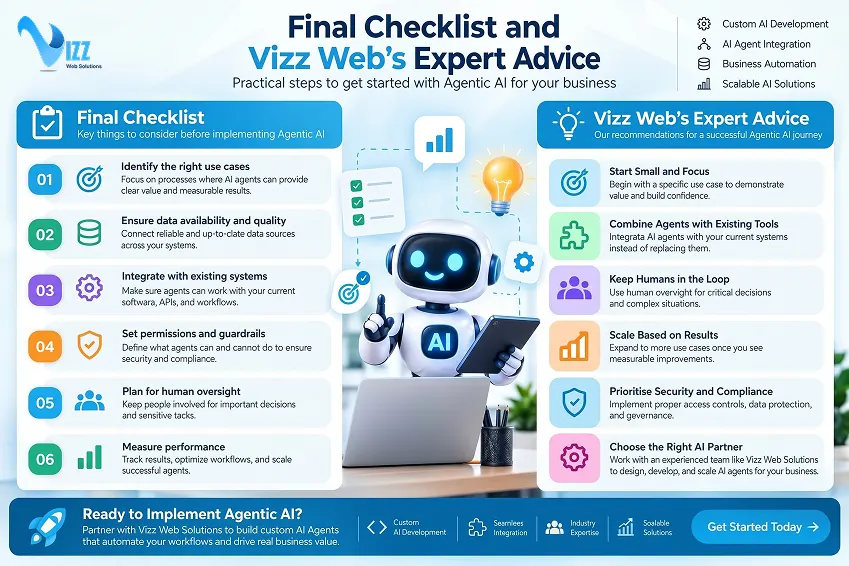
Conclusion
Agentic AI and Autonomous Agents are transforming how businesses use artificial intelligence by enabling systems to reason, use tools, make decisions, and complete multi-step workflows. From real estate and restaurants to manufacturing and logistics, AI agents can automate processes, improve efficiency, and support better customer experiences. Businesses should focus on practical use cases where agentic AI can solve real operational challenges rather than adopting it simply as a trend. By investing in the right data, integrations, security, and infrastructure, organizations can prepare for increasingly autonomous operations.
Talk with our experts at Vizz Web Solutions to build custom AI solutions for your business that combine AI models, software, APIs, automation, and enterprise workflows to turn these opportunities into practical business applications.
FAQs
- What is Agentic AI?
Agentic AI is artificial intelligence that can pursue a defined goal by reasoning, planning, using tools, making decisions, and taking actions with limited human intervention. Unlike a basic chatbot that primarily generates responses, an agent can participate directly in a business workflow.
- What are autonomous AI agents?
Autonomous AI agents are software systems that can perform tasks independently within defined instructions, permissions, and operational boundaries. They can gather information, decide which actions are needed, use connected tools, evaluate results, and escalate situations when human intervention is required.
- What is the difference between AI agents and chatbots?
A chatbot typically responds to user messages. An AI agent can go beyond conversation by planning and executing actions through external tools and business systems. For example, a chatbot can tell a customer that a shipment is delayed, while an agent could investigate the delay, check available options, update the customer, and initiate an approved resolution.
- How can Agentic AI help a business?
Agentic AI can help automate multi-step workflows such as customer support, sales follow-up, scheduling, data analysis, inventory management, document processing, logistics coordination, reporting, and operational monitoring. The greatest value generally comes from workflows where employees repeatedly move information between systems or perform predictable sequences of actions.
- What industries can use Agentic AI?
Almost any industry can potentially use AI agents where there are suitable workflows and data. Particularly relevant applications include real estate, restaurants, manufacturing, logistics and supply chain, finance, healthcare, e-commerce, transportation, education, software development, and customer service.
- How much does it cost to develop an AI agent?
The cost of developing an AI agent depends on its complexity, integrations, data requirements, model selection, number of workflows, security requirements, user volume, and level of autonomy.