


Artificial intelligence is advancing beyond generating text to intelligent agents capable of planning tasks, leveraging tools, interacting with software, and running multi-step workflows. Organizations explore these capabilities to automate operations, enhance customer experience, and connect systems that historically required manual coordination. An agentic AI framework supplies the essential building blocks developers need to design, orchestrate, test, and deploy these autonomous systems.
From customer support agents and research assistants to enterprise automation platforms, selecting the right framework helps convert raw AI capabilities into practical business solutions. However, choosing a framework requires evaluating workflow complexity, model compatibility, system integrations, security, observability, deployment needs, and ongoing maintenance.
This guide defines agentic AI frameworks, reviews popular options, compares core capabilities, and outlines how organizations can select the optimal approach for production-ready AI agent development.
What Is an Agentic AI Framework?
An agentic AI framework is a software development framework that helps developers build AI agents capable of pursuing defined goals, making decisions, using tools, and coordinating tasks within specified boundaries. Unlike a basic large language model application that generates a response to a prompt, an AI agent can interact with external systems, retrieve information, evaluate results, and determine the next step in a workflow.
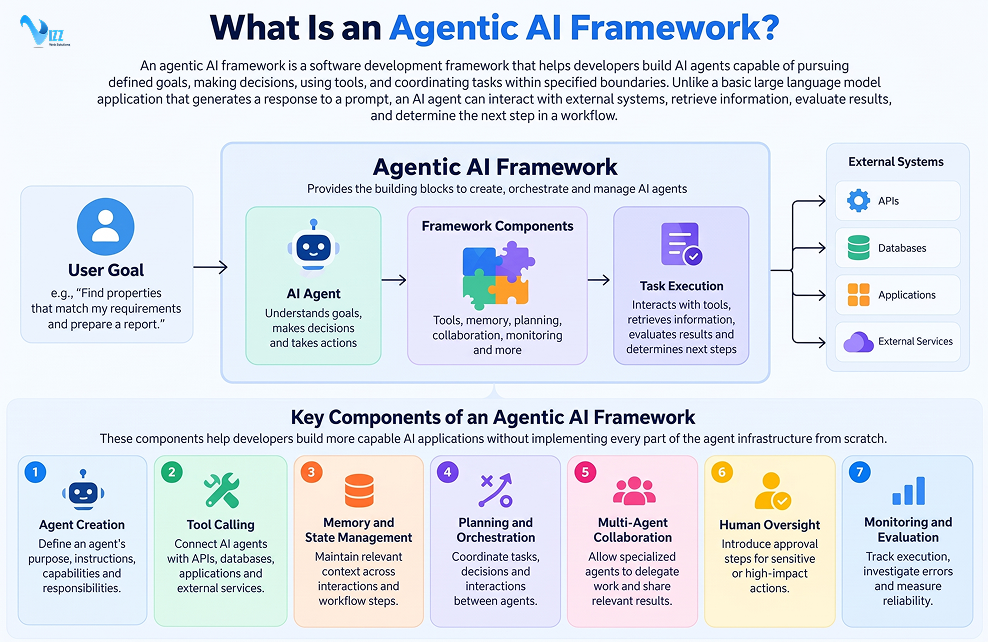
An agentic AI framework typically provides components for:
- Agent creation:Define an agent’s purpose, instructions, capabilities, and responsibilities.
- Tool calling:Connect AI agents with APIs, databases, applications, and external services.
- Memory and state management:Maintain relevant context across interactions and workflow steps.
- Planning and orchestration:Coordinate tasks, decisions, and interactions between agents.
- Multi-agent collaboration:Allow specialized agents to delegate work and share relevant results.
- Human oversight:Introduce approval steps for sensitive or high-impact actions.
- Monitoring and evaluation:Track execution, investigate errors, and measure reliability.
These components help developers build more capable AI applications without implementing every part of the agent infrastructure from scratch.
How Does an Agentic AI Framework Work?
An agentic AI framework connects an AI model with instructions, tools, business data, and an execution environment. The agent receives a goal, evaluates the available information, determines an appropriate action, and uses authorized tools to progress toward the desired outcome.
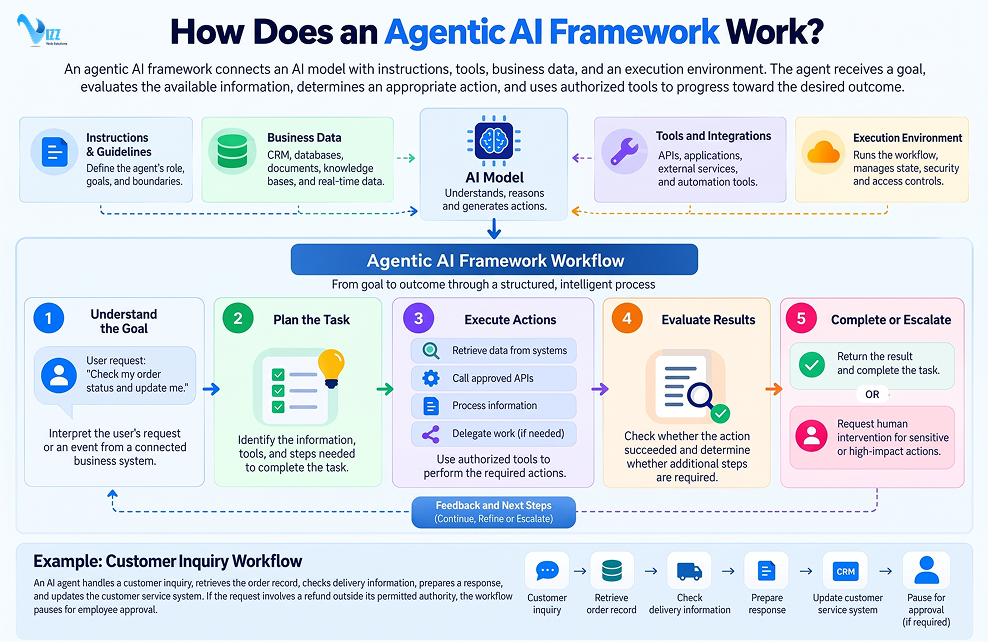
A typical workflow involves five stages:
- Understand the goal:Interpret the user’s request or an event from a connected business system.
- Plan the task:Identify the information, tools, and steps needed to complete the task.
- Execute actions:Call approved APIs, retrieve records, process documents, or delegate work.
- Evaluate results:Check whether the action succeeded and determine whether additional steps are required.
- Complete or escalate:Return the result, continue the workflow, or request human intervention.
For example, an AI agent handling a customer inquiry could retrieve an order record, check delivery information, prepare a response, and update the customer service system. If the request involves a refund outside its permitted authority, the workflow can pause for employee approval.
The framework manages the execution process, but reliability still depends on the quality of the model, tools, data, instructions, and safeguards.
Best Agentic AI Frameworks to Know
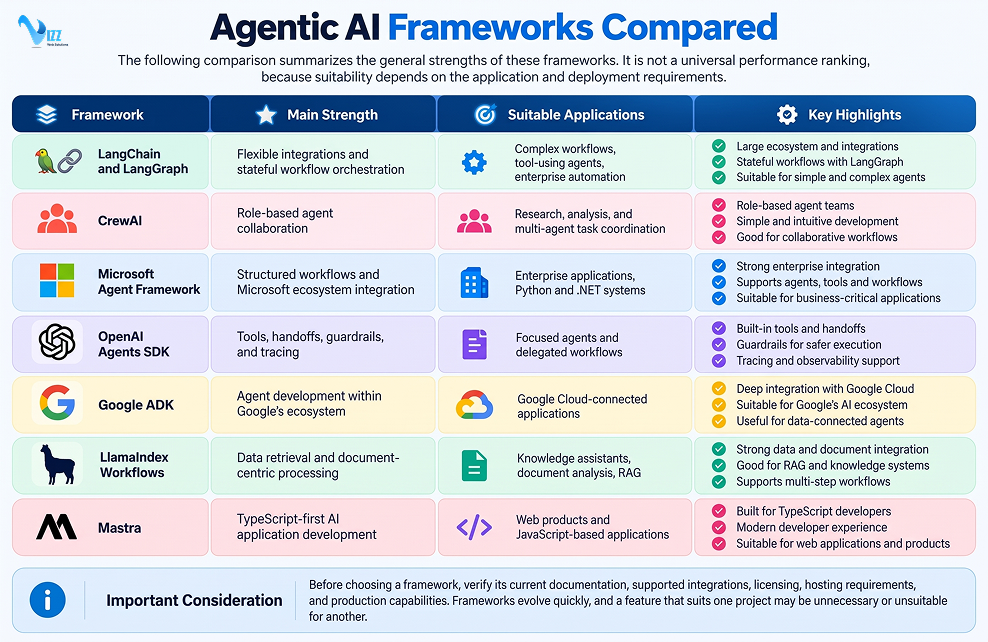
There is no single best AI agent framework for every project. The right choice depends on the application architecture, programming language, preferred AI models, workflow requirements, and production environment.
1. LangChain and LangGraph
LangChain provides components for developing applications powered by language models, including tool integrations and agent building blocks. LangGraph focuses on orchestrating stateful workflows through graph-based execution.
LangGraph is useful when an application needs conditional routing, persistent state, checkpoints, recovery, or human approval. Developers can define how an agent moves between tasks instead of relying entirely on an open-ended reasoning loop.
Common applications include research agents, customer support systems, document processing, and enterprise workflows that require explicit control over execution.
Best for: Flexible AI applications and stateful, multi-step agent workflows.
2. CrewAI
CrewAI provides an approach to coordinating AI agents with defined roles, goals, and tasks. Developers can organize specialized agents into teams and structure how they collaborate to complete a larger objective. For example, a business research workflow might use separate agents for information gathering, analysis, fact checking, and report preparation. CrewAI can be useful for rapid development of collaborative agent systems. However, developers should still evaluate task dependencies, execution control, failure handling, and the cost of unnecessary agent interactions before production deployment.
Best for: Role-based multi-agent collaboration.
3. Microsoft Agent Framework
Microsoft Agent Framework brings together agent development, workflow orchestration, integrations, and operational capabilities for Python and .NET environments. Microsoft describes it as the successor to AutoGen and Semantic Kernel. The framework supports agents, tools, state management, graph-based workflows, and human-in-the-loop execution. This makes it relevant for organizations that need to connect AI agents with established enterprise applications and controlled business processes. Businesses using Microsoft infrastructure may find its integration options and structured workflow capabilities particularly useful.
Best for: Enterprise applications using Microsoft technologies and structured workflows.
4. OpenAI Agents SDK
The OpenAI Agents SDK provides building blocks for developing AI agents with instructions, tools, guardrails, handoffs, and tracing. Developers can build a focused agent that uses approved tools or coordinate multiple agents with different responsibilities. Handoffs allow one agent to delegate a task to a specialist, while guardrails help validate inputs, outputs, and tool interactions. The SDK is suitable for applications that need a relatively lightweight development approach with clear mechanisms for tool use, delegation, and workflow inspection.
Best for: Tool-using agents, task delegation, and controlled agent handoffs.
5. Google Agent Development Kit (ADK)
Google Agent Development Kit provides tools for creating and orchestrating AI agents. It is relevant to teams building applications around Google’s AI ecosystem and cloud infrastructure. Depending on the implementation, developers can organize agents, connect tools, and structure workflows for applications such as research assistants, customer support automation, and enterprise knowledge systems. Teams should evaluate the framework’s current capabilities, model compatibility, hosting options, and integration requirements against their intended architecture.
Best for: Developers building agents within Google Cloud environments.
6. LlamaIndex Workflows
LlamaIndex provides tools for connecting language models with external data, while its workflow capabilities help developers coordinate multi-step processing. This can be useful for applications involving business documents, internal knowledge bases, reports, contracts, and retrieval-augmented generation (RAG). For example, an AI agent could retrieve information from approved documents, extract relevant details, compare records, and prepare a summary for employee review.
Best for: Document-intensive applications and data-connected AI agents.
7. Mastra
Mastra is an AI application framework designed for TypeScript developers. It provides capabilities for agent development, workflows, and related application components. It may be a suitable option for teams building AI features within JavaScript or TypeScript applications, particularly when the surrounding product already uses a modern web technology stack. As with other frameworks, developers should assess model support, deployment architecture, monitoring, and maintenance requirements before selecting it for an enterprise system.
Best for: TypeScript-based AI applications.
Agentic AI Framework vs. AI Agent vs. Multi-Agent System
These terms are related but describe different parts of an AI application.
- An AI agentis the system that uses a model, instructions, tools, and context to pursue a goal and perform tasks.
- An agentic AI frameworkprovides the software components developers use to build and manage that agent, including tool integration, orchestration, state, and execution controls.
- A multi-agent systemconsists of multiple agents that collaborate or delegate work to complete a larger process.
For example, a real estate platform could use a lead qualification agent, a property matching agent, and an appointment scheduling agent. An orchestration layer coordinates their activities, while the underlying framework provides the components needed to implement the system. Not every application needs multiple agents. A single agent or a conventional software workflow may be simpler, cheaper, and more reliable for a narrowly defined task.
How to Choose the Right Agentic AI Framework?
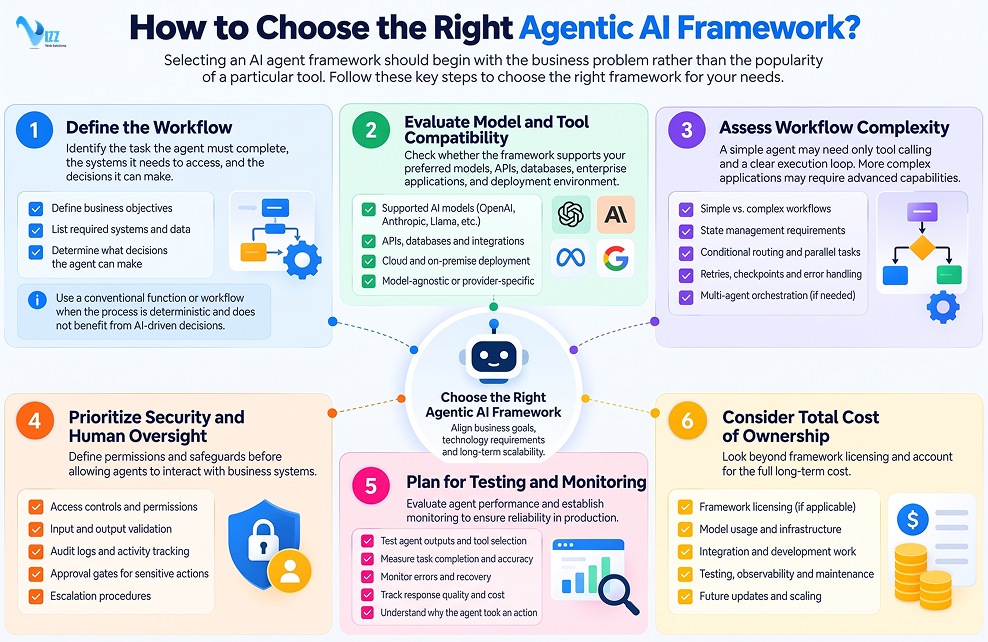
Selecting an AI agent framework should begin with the business problem rather than the popularity of a particular tool.
- Define the Workflow:Focus on the business problem; use traditional code for deterministic tasks and reserve AI for adaptive decisions.
- Evaluate Model & Tool Compatibility:Ensure support for your required models, APIs, databases, enterprise apps, and preferred hosting environments.
- Assess Workflow Complexity:Match framework capabilities, like persistent state, conditional routing, and multi-agent orchestration, to your task’s needs.
- Prioritize Security & Oversight:Implement strict permissions, access controls, audit logs, and human-in-the-loop approval gates for high-risk actions.
- Plan for Testing & Monitoring:Track accuracy, tool usage, error recovery, and failure points to ensure full observability in production.
- Consider Total Cost of Ownership:Account for infrastructure, API usage, integration, testing, observability, and long-term maintenance costs.
Building Production-Ready Agentic AI Systems
Building production-ready AI agents requires reliable data, clear tool interfaces, security controls, and measurable acceptance criteria. Success starts with a focused use case tested under real operating conditions before expanding to specialized multi-agent setups. Enterprise deployments must strictly address data privacy, retention, access permissions, and regional hosting compliance (across the USA, Canada, UK, and Europe). Rather than maximizing autonomy, the objective is granting agents sufficient authority to complete useful work while keeping actions observable, controlled, and recoverable.
Custom Agentic AI Development With Vizz Web Solutions
While pre-packaged AI frameworks offer useful starting points, modern businesses require tailored solutions designed to match their specific workflows, data architectures, existing software ecosystems, and security standards. Vizz Web Solutions bridges this gap by merging core AI engineering with full-stack development, seamless API integration, database management, and enterprise-grade automation. Our key capabilities & approach include:
- Tailored AI Architecture: Moves beyond off-the-shelf limits to fit your specific workflows, software stack, data structures, and security requirements.
- 17+ Years of Proven Experience: Leverages over 1,200 delivered software services to guide framework evaluation and strategic technology selection.
- Full-Stack & Systems Integration: Combines AI engineering with full-stack software development, robust API integrations, enterprise automation, and databases.
- Multi-Agent Orchestration & Operations: Connects custom AI agents to existing applications, enables complex multi-agent orchestration, and establishes reliable testing and monitoring processes.
- Goal-Oriented Deployment: Focuses on clear business objectives and practical deployment plans across various use cases, including customer support agents, document processing workflows, real estate assistants, and enterprise automation platforms.
Partnering with Vizz Web Solutions ensures your transition from initial concept to a production-ready agentic system is efficient, secure, and fully aligned with your long-term business goals.
Conclusion
Agentic AI frameworks provide the essential foundation for tool use, task coordination, and multi-step workflow execution. Frameworks like LangGraph, CrewAI, Microsoft Agent Framework, OpenAI Agents SDK, Google ADK, LlamaIndex Workflows, and Mastra each offer unique approaches. Selecting the right framework depends on workflow complexity, integrations, model compatibility, security, monitoring, and operating costs. Organizations should begin with a clearly defined use case, expanding agent autonomy only after meeting reliability and governance standards. Strategic framework selection enables businesses to transition from simple AI interactions to intelligent, operationally practical systems.
FAQs
- What is an agentic AI framework?
An agentic AI framework is a development platform that helps build AI agents capable of planning tasks, using tools, making decisions, and completing multi-step workflows.
- Which agentic AI framework is best?
The best framework depends on your requirements. LangGraph suits complex workflows, CrewAI supports collaborative agents, and OpenAI Agents SDK provides tools, handoffs, and guardrails.
- What is the difference between LangChain and LangGraph?
LangChain provides components for building LLM-powered applications, while LangGraph focuses on stateful, controllable workflows and agent orchestration.
- Can agentic AI frameworks be used for enterprise applications?
Yes, agentic AI frameworks can support enterprise automation, customer service, data processing, and system integration when combined with appropriate security and monitoring.
- Can businesses develop custom agentic AI frameworks?
Yes, businesses can build tailored agentic AI solutions using existing frameworks or custom components to meet their specific workflows, integration, and security requirements.