



Agentic AI Development and Autonomous Agents Deployment: Enterprise Case Study
Executive Summary
Businesses are moving beyond traditional automation and basic AI assistants toward systems that can understand goals, make decisions, use software tools, and execute multi-step workflows. This case study explores how Vizz Web Solutions can design and deploy an enterprise Agentic AI system connecting autonomous agents with business applications, APIs, databases, knowledge systems, workflow automation, and human oversight. Read More

Case Study Profile & Scope
The organizations in this case study manage complex operations across multiple business functions using CRMs, databases, business applications, communication platforms, and other enterprise systems. Employees still spend significant time coordinating workflows, moving information between systems, processing documents, and handling repetitive decisions. Agentic AI can connect these systems, gather information, take approved actions, coordinate tasks, and escalate important decisions. This helps businesses reduce manual operational work while keeping employees involved where human judgment is required.
The Business Challenge
The organization was not looking for another chatbot. Its existing software could store information, trigger automated actions, and provide employees with dashboards. However, these systems generally depended on people to decide what should happen next. A typical process required an employee to:
Receive a request or business event.
Search multiple systems for relevant information.
Review the available data.
Determine the appropriate next action.
Update one or more systems.
Communicate with another person or department.
Monitor the result.
Follow up if the process did not complete successfully.
Several challenges emerged:
Fragmented Business Data
Information was distributed across databases, CRM systems, documents, applications, APIs, and internal knowledge sources.
Repetitive Operational Work
Employees spent considerable time performing repetitive searches, data entry, follow-ups, scheduling, reporting, and system updates.
Slow Cross-System Workflows
A task that required information from multiple systems often depended on employees manually collecting and comparing information.
Limited Automation
Traditional automation handled predictable rules effectively but struggled when a process required interpretation, changing conditions, or decisions.
Lack of Continuous Workflow Monitoring
Employees often had to monitor processes themselves and identify exceptions that required attention.
Need for Controlled AI Adoption
The organization wanted AI to perform useful work without giving an AI system unrestricted access to sensitive business systems.
The Agentic AI Solution
Vizz Web Solutions designed an Agentic AI architecture around the organization's actual workflows rather than starting with a particular AI model or framework. The objective was to create AI agents capable of:
Rather than deploying one general-purpose AI agent, the architecture used specialized agents for different operational responsibilities.
Specialized AI Agents
The proposed system used specialized AI agents, each focused on a defined business function within controlled boundaries. Agents handled customer requests, research, operations, document processing, scheduling, support, and analytics, while an Orchestrator Agent coordinated tools, approvals, and workflows. Each agent had role-based access to relevant systems, ensuring tasks were performed within defined permissions while exceptions could be escalated to human teams.
Orchestrator Agent
Coordinated tools, approvals, and workflows.
Customer Requests Agent
Handled customer inquiries and communication.
Scheduling Agent
Managed calendar bookings and appointments.
Document Processing Agent
Handled documents, forms, and extraction.
Research Agent
Retrieved information across enterprise knowledge bases.
Operations Agent
Executed cross-system operational tasks.
Support Agent
Managed support tickets and escalated issues.
Analytics Agent
Monitored performance metrics and reporting.
How the Agentic AI Workflow Worked
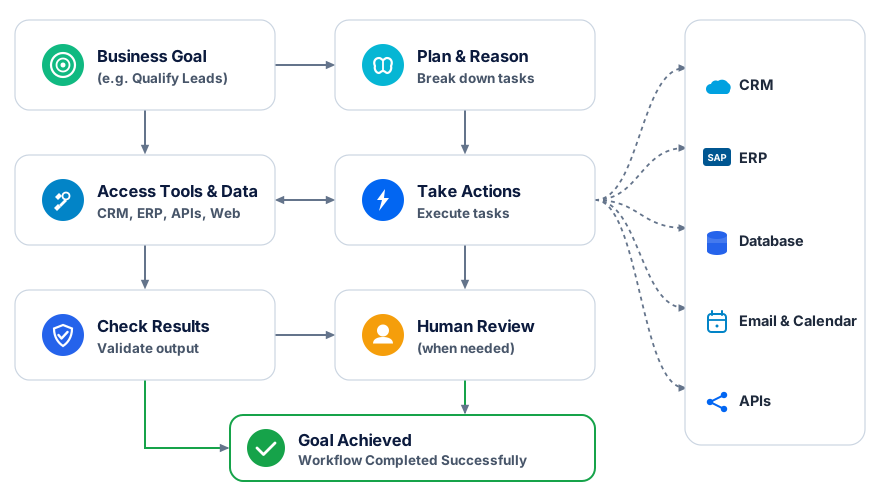
The deployment transformed selected business processes from manually coordinated workflows into controlled agent-driven workflows. A typical workflow followed this pattern:
A Business Event Occurs
A customer request, new lead, document, operational event, system notification, or scheduled task triggers the workflow.
The Orchestrator Determines the Required Action
The orchestration layer evaluates the request and determines which specialized agent should handle the next step.
The Agent Retrieves Relevant Information
The agent accesses approved databases, documents, APIs, knowledge bases, or business applications.
The Agent Reasons Over the Information
The agent evaluates the available information against business rules, instructions, context, and workflow requirements.
The Agent Uses Connected Tools
The agent can perform approved actions through APIs, application integrations, databases, calendars, CRM systems, or other connected tools.
Results Are Verified
The system evaluates whether the action produced the expected result.
Exceptions Are Escalated
If the workflow reaches a sensitive decision, unexpected condition, permission boundary, or low-confidence situation, the system routes the task to a human.
The Workflow Is Recorded
Relevant actions, decisions, errors, approvals, and outcomes can be logged for monitoring and auditing.
Integrating Autonomous Agents With Existing Business Systems
A major requirement of the deployment was ensuring that AI agents could work with existing software rather than creating an isolated AI environment. Vizz Web AI development experts can integrate agents with systems such as:
For example, when a new customer request arrives, an AI agent can retrieve the relevant customer record, review previous interactions, determine the appropriate workflow, update the CRM, schedule an appointment, and send an approved communication. The agent is not simply generating text. It is participating in the workflow through controlled software integrations.
Human-in-the-Loop Deployment
Human oversight remains an important part of the architecture. Not every decision should be automated. The system can identify workflows that require human involvement and create approval checkpoints. For example:
Researches the request → gathers relevant data → prepares a recommendation → presents the proposed action
Reviews the recommendation → approves or modifies the action
Executes the approved action → records the result → continues the workflow
Deployment Strategy: Start With One Workflow
Vizz's approach does not require an organization to automate every business process at once. The deployment can begin with a single high-value workflow. For example:
Identify
Select a repetitive, measurable workflow with clear business value.
Design
Map the workflow, identify required data and tools, define permissions, and determine where humans must remain involved.
Build
Develop the AI agent, integrations, knowledge layer, orchestration, and user interface.
Evaluate
Test normal workflows, edge cases, incorrect inputs, failures, security boundaries, and human escalation.
Deploy
Release the agent into a controlled production environment with monitoring and appropriate permissions.
Scale
Once the workflow demonstrates reliable performance, additional agents and workflows can be introduced.
Business Impact
The deployment focused on improving how work gets done rather than simply introducing AI technology. Agentic AI can reduce manual coordination, accelerate routine workflows, improve access to business information, and allow employees to focus on tasks requiring human judgment. Key areas of impact include:
Reduced Manual Work
Automate repetitive tasks such as data retrieval, entry, scheduling, follow-ups, and document processing.
Faster Workflows
Enable agents to work across connected systems without constant manual intervention.
Better Visibility
Monitor workflow status, exceptions, failures, and outstanding tasks.
Consistent Processes
Execute workflows according to defined instructions, business rules, permissions, and escalation requirements.
Improved Customer Response
Handle routine requests and escalate complex cases with relevant context.
Scalable Automation
Expand from individual AI agents to multiple specialized agents as business needs grow.
Key Lessons From the Deployment
The case study highlights several important principles for organizations adopting Agentic AI.
Start With the Business Problem
The strongest AI deployments begin with a measurable operational challenge rather than an AI model.
Give Agents Clear Responsibilities
Specialized agents with defined permissions are easier to evaluate, monitor, and control.
Integrate With Existing Systems
The value of an AI agent increases when it can work with the software employees already use.
Keep Sensitive Decisions Under Human Control
Autonomy should be matched to the risk and importance of the workflow.
Treat Evaluation as Part of Development
Agents require continuous testing and performance evaluation after deployment.
Build for Scale
The architecture should allow organizations to begin with one workflow and expand to additional agents as business value is demonstrated.
Conclusion
Agentic AI extends traditional automation by enabling software systems to reason through tasks, use tools, interact with business applications, and complete multi-step workflows within defined boundaries. This case study demonstrates how specialized agents, orchestration, enterprise data, RAG, APIs, security controls, monitoring, and human oversight can work together in a production environment.
Rather than automating everything at once, businesses can start with a high-value workflow, measure results, and gradually expand into multi-agent operations. Vizz Web Solutions helps businesses move from AI experimentation to practical Agentic AI deployment through AI engineering, software development, enterprise integrations, automation, and scalable infrastructure.
Ready to Deploy Autonomous AI Agents for Your Enterprise?
Connect directly with our senior Agentic AI architects and workflow automation specialists. Whether you want to evaluate an initial operational workflow, connect autonomous agents with your existing CRMs, ERPs, and databases, or engineer a full-scale multi-agent platform with human oversight, we're ready to engineer your solution.