



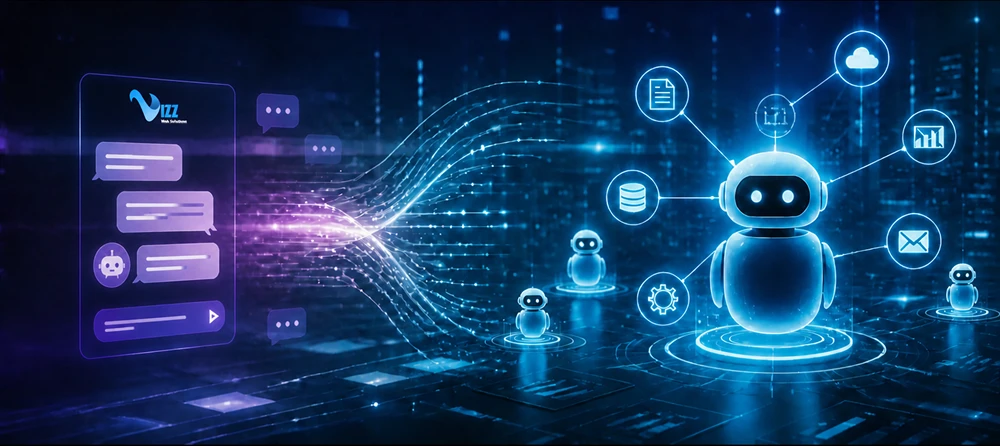
For the past few years, the corporate world has fallen into a predictable pattern with Artificial Intelligence. Companies rushed to bolt basic chatbots or “AI assistants” onto their existing websites and software. A user would type a prompt, the AI would generate a piece of text or a quick answer, and a human operator would still have to do all the heavy lifting to actually execute the task.
That era is officially over.
In mid-2026, the global tech landscape was experiencing a massive structural shift. We have moved from simple generative AI to Agentic AI, autonomous software systems that don’t just answer questions, but actively execute multi-step workflows, make decisions, connect to internal APIs, and manage entire operations without constant human supervision.
According to recent data from Gartner, approximately 40% of all enterprise software applications now feature embedded AI agents running autonomous workflows. The business conversation has dramatically shifted from “How can AI help me write an email?” to “How many autonomous digital workflows can we deploy this quarter to scale our operations?”
For forward-thinking enterprises and software houses, mastering this transition is no longer a luxury. It is the defining competitive advantage of the year.
From Prompting to Delegating: The New Reality of Software
To understand why this shift matters to modern business clients, you have to look at how traditional software operates. For a decade, standard Software-as-a-Service development focused purely on digitizing tasks. A Customer Relationship Management (CRM) system or an Enterprise Resource Planning (ERP) platform gave humans a clean dashboard to store data, send emails, and track sales pipelines.
However, the human worker remained the ultimate bottleneck. A person still had to log into the CRM, manually find cold leads, figure out what to say, type the follow-up, and click send. Agentic workflows completely rewrite this playbook. Instead of a human using a tool, the AI agent becomes the operator of the tool.
[Traditional AI Architecture: 2024]
Human Prompt ──> Static LLM Inference ──> Text Output ──> Human Must Execute Task
[Modern Agentic Architecture: 2026]
Human Intent ──> Agent Planner ──> Dynamic Tool Use (APIs/Databases) ──> Self-Reflection/QA ──> Autonomous Goal Achievement
When an enterprise deploys an agentic framework today, the workflow behaves like an independent, goal-driven team member. For example, instead of waiting for an employee to look at a data dashboard, an autonomous agent can:
- Monitor an internal database for inactive user accounts.
- Autonomously trigger a localized research task across public directories to see if the client’s business model has shifted.
- Craft a deeply personalized, context-aware outreach sequence.
- Execute the email or API call directly through integrated communication networks.
The human’s role changes from doing the manual execution to setting the strategic guardrails. You no longer write the code or type the response, you manage the agent’s permission levels.
The Core Technical Engine: Inside the 2026 Agentic Stack
Building these systems requires moving past a basic OpenAI or Anthropic API connection. Modern production-grade software architectures combine multiple specialized layers to ensure the AI remains accurate, secure, and grounded in real-world business data.
Engineering teams building scalable enterprise applications in 2026 utilize a highly specific stack to prevent the common pitfalls of early AI models, such as “hallucinations” (generating false information) or architectural drift.
1. The Orchestration Layer (LangGraph & Mastra)
A single model cannot handle a complex corporate workflow alone. Advanced developers use event-driven agent frameworks like LangGraph or TypeScript-native tools like Mastra to build multi-agent loops. These frameworks allow software engineers to model AI behaviors exactly like real-world corporate departments, creating specialized agents with clear roles, such as a “Researcher Agent,” a “Writer Agent,” and a “Compliance QA Agent.”
2. Model Context Protocol (MCP) and Real-Time Data Integration
An AI model is only as smart as the data it can access. The introduction of open-standard integration systems like the Model Context Protocol (MCP) allows language models to seamlessly interface with secure enterprise databases, local development environments, and secure file storage layers in real-time. This guarantees the agent is acting on live inventory counts, actual billing data, or current customer histories, not outdated public training records.
3. Deep RAG (Retrieval-Augmented Generation) Pipelines
For data-heavy industries like healthcare, logistics, and legal services, precision is non-negotiable. Modern tech architecture utilizes advanced LlamaIndex Workflows to build deep RAG pipelines. These systems parse massive document corpora, convert them into vector data, and feed exact textual truths directly into the AI’s short-term memory window, minimizing errors to near zero.
The Economic Reality: Slashing Legacy Software Costs
The real reason enterprise executives are hyper-focusing on Agentic AI in 2026 isn’t just because the technology is fascinating, it’s because it fundamentally alters the corporate balance sheet. For the last 15 years, corporations have been trapped in expensive, rigid seat-licensing models with massive legacy software vendors. Every time a company scales its customer support, sales, or logistics team, it has to purchase dozens of new software licenses for platforms like Salesforce, SAP, or Oracle.
Agentic AI breaks this cycle. Because an autonomous agent can connect directly to underlying databases via secure APIs, it can query, update, and manage data without needing to click through a premium user interface.
The 2026 Cost Paradigm: Why pay for 200 software seat licenses just for data entry and basic pipeline routing when a custom multi-agent platform can execute those database updates directly at a fraction of the infrastructure cost?
Engineering teams deploying these autonomous agents are reporting up to 70% faster operational deployment cycles. The core roadblock in business transformation was never how long it took to write code or inputs; it was the endless coordination, manual data handoffs, and system-to-system friction. By allowing autonomous agents to negotiate tasks directly using secure Agent-to-Agent (A2A) communication protocols, that corporate friction completely evaporates.
How Multi-Agent Teams Accelerate Product Development
To see this transformation in action, look no further than how cutting-edge custom software development itself has changed. The old model of software production was entirely linear, an architect wrote a specification document, a backend developer built an API, a frontend developer styled the user interface, a QA engineer wrote test scripts, and a project manager spent hours trying to sync their calendars.
In 2026, leading software development pipelines use specialized, parallel multi-agent teams running on engines like Claude Code or custom enterprise runtimes:
- The Tech Lead Agent: Receives a plain-English product requirement, maps out the software architecture, and outlines the precise API endpoints needed.
- The Backend Agent: Autonomously writes clean, type-safe code (often using modern full-stack frameworks like Next.js) and configures database migrations.
- The Frontend Agent: Consumes the new API data structures and builds responsive, production-ready user interfaces in parallel.
- The QA & Reflection Agent: Runs automated test suites, actively intercepts syntax errors, deploys edge-case checks, and recursively fixes bugs before a human ever reviews the code repository.
This isn’t an experimental lab concept; it is how elite engineering teams operate today. By handling the baseline “boilerplate” mechanics of software development automatically, senior human engineers can spend 100% of their mental energy on high-level systems design, deep security reviews, and strategic product innovation.
Future-Proofing for the Enterprise Client
As we move deeper into 2026, the tech divide will widen rapidly. Companies that continue to treat AI as a glorified typewriter or a basic customer-facing FAQ bot will find themselves bogged down by high operational overhead and slow go-to-market speeds.
On the other side, forward-thinking enterprises are already partnering with specialized software houses to build custom, proprietary agentic platforms. They aren’t buying off-the-shelf software, they are building internal digital asset ecosystems tailored specifically to their proprietary data, compliance rules, and operational workflows.
The mandate for businesses looking to project genuine industry authority to their clients is clear: focus on measurable, near-term impact. Stop investing in broad, abstract AI promises. Instead, build clean, modular, and secure software architectures that turn intent into autonomous action. The future belongs to those who build the systems that execute.