




Executive Summary
Real estate businesses depend on timely communication to convert property inquiries into viewings, sales, and rental agreements. However, agents are frequently occupied with property tours, negotiations, meetings, and client appointments. As a result, incoming calls can go unanswered, after-hours inquiries may be missed, and prospective buyers or tenants may contact competing agencies instead. This case study explores how Vizz Web Solutions can develop and deploy AI Voice Agents and Enterprise AI Receptionists for the real estate industry using Agentic AI, autonomous agents, and enterprise system integration.
The proposed solution answers incoming calls, qualifies leads, provides property information, schedules viewings, routes maintenance requests, and records interactions in connected business systems. It helps real estate organizations provide consistent communication while allowing human teams to focus on complex inquiries and high-value customer relationships.
Case Study Profile & Scope
Industry: Residential and Commercial Real Estate
Market and Scope: USA, UK, Europe, and International Markets
Operations: Inbound call handling, lead qualification, property inquiries, appointment scheduling, tenant support, maintenance requests, and CRM updates
Technology Environment: Telephony systems, CRM platforms, property databases, property management software, APIs, calendars, and AI voice technologies
Real estate organizations often manage calls from buyers, sellers, tenants, landlords, contractors, and property investors through a shared telephone system. When these interactions depend entirely on human receptionists, teams may struggle with peak call volumes, after-hours coverage, and consistent information handling. An enterprise AI receptionist can connect telephone conversations with property data and operational workflows, helping businesses manage these interactions more efficiently.
The Business Challenge: Missed Calls and Fragmented Communication
The organization represented in this case study faced challenges managing incoming calls across sales, leasing, and property management. Agents could be unavailable while showing properties, reception staff had to identify the correct department for each caller, and after-hours inquiries often required manual follow-up. These challenges affected more than customer service. A missed buyer inquiry could mean a lost viewing opportunity, while an unanswered tenant maintenance call could delay the reporting and assessment of a property issue. Staff also spent time recording call notes, updating customer records, transferring messages, and coordinating appointments.
Traditional automated phone menus can route callers through predefined options, but they generally cannot manage the full conversation or independently coordinate complex workflows. The business needed a solution that could understand caller intent, retrieve relevant information, and take appropriate actions within defined permissions.
The AI Voice Agent Solution by Vizz Web Solutions
Vizz Web Solutions approaches this challenge by developing a custom AI voice agent that works as an intelligent first point of contact for the real estate business. Rather than operating as an isolated answering service, the agent connects telephone conversations with CRM systems, property databases, calendars, and property management software.
The proposed enterprise AI receptionist can:
- Answer calls around the clock: Handle routine inquiries during office hours, evenings, weekends, and holidays.
- Qualify property leads: Collect information about budgets, locations, property preferences, purchase timelines, and rental requirements.
- Provide property information: Retrieve approved listing details, prices, amenities, and availability from connected data sources.
- Schedule viewings: Check available appointment slots and initiate or confirm bookings according to business rules.
- Route calls intelligently: Direct callers to sales, leasing, accounts, maintenance, or other appropriate departments.
- Support existing tenants: Record maintenance requests, answer approved property-related questions, and provide service updates.
- Update business systems: Log conversations, summarize calls, create lead records, and record the required next steps.
- Escalate complex requests: Transfer callers to human employees when a request requires professional judgment or falls outside the agent’s permissions.
This approach moves beyond automated call answering toward intelligent voice-based workflow automation.
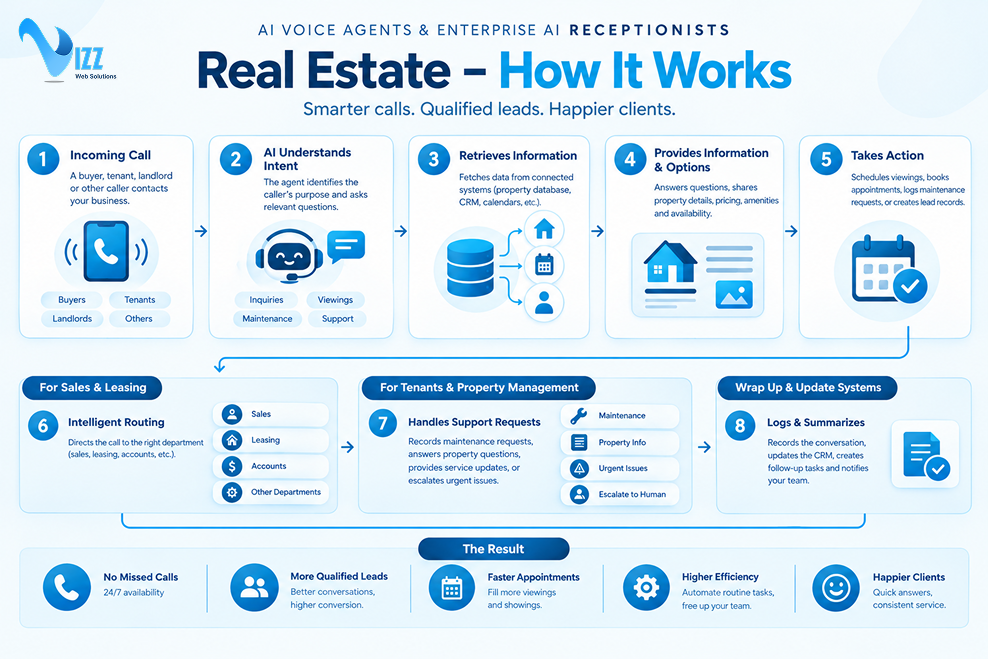
How the Enterprise AI Receptionist Works
The workflow begins when a buyer, tenant, landlord, or other caller contacts the real estate organization. The AI voice agent identifies the caller’s intent, asks relevant questions, and retrieves information from authorized business systems. For example, a prospective buyer may call about a two-bedroom apartment advertised online. The agent can retrieve the relevant listing, answer questions using current property information, collect the buyer’s requirements, and check available viewing appointments. Once the caller selects a suitable time, the system can initiate the booking, update the CRM, and notify the assigned sales representative.
A tenant calling about a maintenance issue follows a different workflow. The agent gathers the relevant details, identifies the property, records the request, and applies predefined escalation rules. Urgent safety-related issues can be routed to the appropriate emergency contact or on-call team rather than entering the routine maintenance queue. After each interaction, the system can create a call summary, record the outcome, and identify outstanding actions. This gives employees useful context without requiring them to listen to every call or manually reconstruct the conversation.
From an AI Receptionist to Autonomous Voice Agents
A conventional AI receptionist primarily answers calls and responds to questions. An Agentic AI voice agent can go further by using connected tools to complete multi-step tasks within approved boundaries. For example, a voice agent can qualify a buyer, retrieve suitable properties, check calendar availability, initiate a viewing booking, and update the CRM. Each action depends on the available integrations, data quality, and permissions configured for the deployment.
A goal-based agent in AI can work toward an objective such as arranging a property viewing, while a planning agent coordinates the steps required to complete the task. A knowledge-based agent uses approved property information and business rules to provide relevant responses. An orchestration layer coordinates these capabilities and determines when a request needs human intervention. For larger real estate organizations, multiple specialized agents can handle sales inquiries, leasing, tenant support, maintenance, and appointment scheduling. These agents can operate through a shared platform while maintaining defined responsibilities and access controls.
Technology, Integration, and Enterprise Deployment
Vizz Web Solutions can design the solution around an organization’s existing technology environment instead of requiring a complete replacement of its telephone or property management systems. Depending on the project requirements, the architecture may combine real-time speech processing, AI models, text-to-speech technology, telephony APIs, Python, Node.js, CRM integrations, databases, and retrieval-augmented generation (RAG). Integrations can connect the voice agent with property listings, customer records, calendars, maintenance systems, and internal knowledge sources.
Enterprise deployment also requires careful attention to call quality, response latency, concurrent call volumes, data access, and failure handling. The system should verify property availability against reliable source data, record completed actions, and provide a clear handoff when a request cannot be handled confidently.
For international operations, multilingual voice capabilities can help organizations communicate with buyers, tenants, and investors across different markets. Language selection, regional terminology, accents, and localized business rules should be tested before deployment. Call recording, personal data handling, and automated interactions must also be designed around applicable privacy and regulatory requirements in the markets where the organization operates.
Business Impact and Expected Benefits
An AI voice agent can help real estate organizations improve call coverage, reduce repetitive administrative work, and provide more consistent communication across sales and property management. Potential benefits include:
- Fewer unanswered calls and missed property inquiries.
- Faster lead qualification and viewing coordination.
- More consistent recording of customer interactions.
- Reduced manual call routing and message taking.
- Better tenant support and maintenance request tracking.
- Improved visibility into call outcomes and outstanding tasks.
- Greater capacity to manage call volumes across multiple offices and properties.
Performance should be evaluated against baseline metrics such as call answer rate, abandoned call rate, lead qualification completion, viewing bookings, successful call transfers, maintenance escalation accuracy, and cost per handled interaction. Actual results depend on call volume, system integration, implementation quality, and employee adoption.
Why Choose Vizz Web Solutions for AI Voice Agent Development?
Vizz Web Solutions combines AI development, software engineering, and enterprise system integration to build custom voice automation around real business requirements. With 14+ years of software development experience and more than 1,200 software services delivered, Vizz Web can help real estate organizations connect customer conversations with their existing applications and operational workflows.
From intelligent call handling and lead qualification to multilingual voice agents, CRM integration, appointment scheduling, and multi-agent orchestration, Vizz Web develops solutions designed around each organization’s processes, technology environment, and growth objectives.
Conclusion
AI Voice Agents and Enterprise AI Receptionists are creating new opportunities for real estate businesses to improve communication, capture property inquiries, and coordinate operational workflows. By combining Agentic AI, voice technology, enterprise integrations, and controlled autonomy, Vizz Web Solutions can help real estate organizations move beyond basic call answering toward intelligent voice-based operations. The goal is not simply to automate reception, but to connect conversations with meaningful business actions while keeping human professionals in control of important decisions.