



Manufacturing businesses operate through interconnected processes involving production planning, equipment monitoring, quality control, inventory management, procurement, and supply chain coordination. As these operations become more complex, traditional automation and disconnected software systems can struggle to manage decisions that require information from multiple departments. Agentic AI in manufacturing introduces a more intelligent approach. Instead of simply following predefined instructions or generating recommendations, AI agents can analyse business information, plan tasks, interact with authorised systems, execute workflows, and evaluate outcomes within defined permissions.
For manufacturers looking to improve operational efficiency, reduce manual coordination, and modernise industrial processes, Agentic AI offers opportunities to build more responsive and connected operations.
At Vizz Web Solutions, we develop custom Agentic AI solutions that connect intelligent agents with existing business applications, databases, APIs, and operational systems. This case study explores how Vizz Web can address common manufacturing challenges through autonomous AI agents, multi-agent orchestration, and intelligent workflow automation.
Case Study Profile & Scope
Industry: Manufacturing and Industrial Operations
Market and Scope: USA, North America, Europe, and Global
Operations: Production planning, predictive maintenance, equipment monitoring, quality control, inventory management, procurement, supply chain coordination, demand forecasting, energy management, and operational reporting.
Technology Environment: Manufacturing Execution Systems (MES), Enterprise Resource Planning (ERP) platforms, CRM systems, IoT devices, warehouse management systems, production databases, supplier platforms, APIs, cloud infrastructure, and AI models.
Solution: Custom Agentic AI Manufacturing Platform powered by specialised AI agents and multi-agent orchestration.
Key Applications: Predictive maintenance, production scheduling, quality inspection, inventory optimisation, procurement automation, equipment monitoring, and production optimisation.
Integration: ERP, MES, CRM, IoT platforms, warehouse management systems, databases, and third-party business applications.
Manufacturing businesses often manage complex operations involving production facilities, machinery, suppliers, inventory, workforce activities, and customer orders. Manual coordination across disconnected systems can make it difficult to respond quickly to equipment issues, production delays, material shortages, and changing demand. Agentic AI can connect these workflows through specialised autonomous agents that analyse operational information, coordinate tasks, interact with authorised business systems, and support more efficient industrial operations.
Case study approach: This is a solution-focused enterprise case study illustrating how Vizz Web Solutions can design and implement Agentic AI solutions for manufacturing businesses. It does not claim a specific completed client deployment or independently verified performance results.
The Challenge: Complex Manufacturing Operations and Disconnected Systems
Manufacturing companies frequently use multiple software platforms to manage production, inventory, procurement, equipment, workforce activities, and customer orders. Although these systems provide valuable information, coordinating decisions across them can require significant manual effort. For example, an unexpected equipment failure may affect production schedules, raw material requirements, delivery commitments, and workforce allocation. Conventional automation may trigger an alert, but employees still need to investigate the situation and coordinate the necessary responses.
Common challenges include:
- Production delays: Limited coordination between production schedules, material availability, and customer orders.
- Equipment downtime: Difficulty identifying maintenance requirements before equipment failures disrupt operations.
- Quality control issues: Delays in identifying defects and connecting inspection results with production information.
- Inventory inefficiencies: Overstocking, shortages, and inaccurate demand forecasts.
- Procurement bottlenecks: Manual supplier communication, purchase order processing, and approval workflows.
- Disconnected systems: Limited integration between ERP, MES, warehouse management, and equipment monitoring platforms.
- Operational reporting: Employees spend time collecting information from different systems to prepare reports.
These challenges create opportunities for AI automation in manufacturing, particularly where multiple systems and departments must coordinate to complete a task.
Vizz’s Solution: An Integrated Agentic AI Manufacturing Platform
Vizz Web Solutions approaches these challenges by designing a customised Agentic AI platform that connects specialised AI agents with existing manufacturing infrastructure. Instead of relying on one general-purpose AI assistant, the proposed architecture uses multiple agents, each assigned a specific operational responsibility. These Manufacturing AI Agents communicate through an orchestration layer, exchange relevant information, and coordinate tasks according to predefined business rules and permissions.
Key AI Agents and Their Responsibilities
A manufacturing-focused Agentic AI platform uses specialised agents to manage different operational functions while working together through a central orchestration system. Each agent has defined responsibilities, accesses relevant business systems, and coordinates authorised tasks to improve manufacturing efficiency and operational visibility.
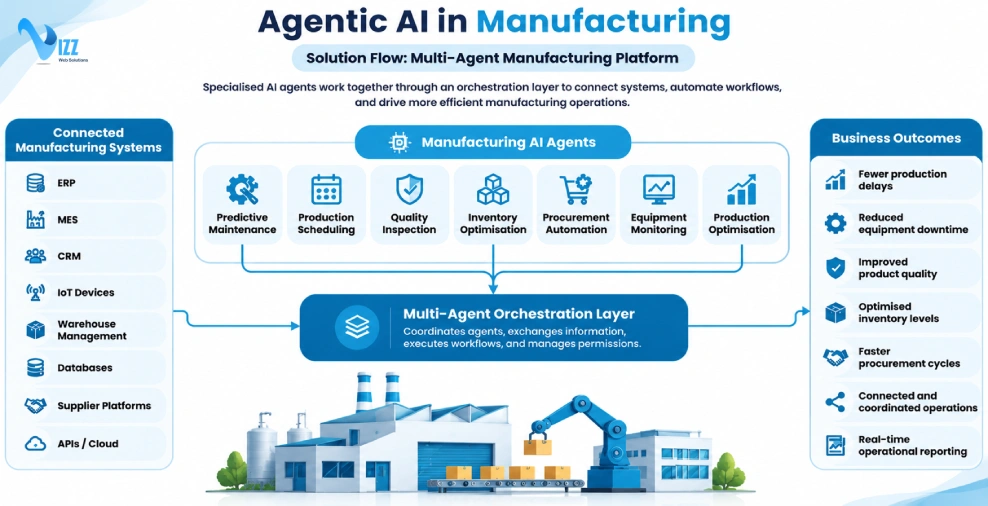
- Predictive Maintenance Agent: Monitors equipment data, maintenance records, and operational alerts to identify potential maintenance requirements. It can prepare maintenance requests, notify relevant teams, and coordinate approved maintenance workflows.
- Production Planning Agent: Reviews production orders, available resources, inventory levels, and delivery requirements. It can identify scheduling conflicts and recommend or initiate authorised adjustments.
- Quality Control Agent: Analyses inspection records, production information, and quality reports to identify unusual patterns and flag potential defects for further investigation.
- Inventory Management Agent: Monitors stock levels, material consumption, purchase orders, and demand forecasts. It can identify potential shortages and prepare replenishment requests.
- Procurement Agent: Coordinates supplier information, purchase requests, quotations, and order documentation. It can prepare procurement workflows while keeping purchasing approvals under human control.
- Supply Chain Coordination Agent: Monitors order status, supplier updates, shipment information, and delivery schedules to identify disruptions and coordinate responses.
- Reporting and Analytics Agent: Collects information from connected systems and generates operational summaries covering production, inventory, maintenance, quality, and performance indicators.
Together, these agents form multi-agent AI systems for manufacturing, allowing different operational functions to work through a connected intelligent environment.
How Agentic AI Works in Manufacturing
The platform follows a structured workflow that connects business objectives with authorised actions.
- Step 1 – Collect Operational Information: AI agents retrieve relevant information from ERP systems, Manufacturing Execution Systems (MES), warehouse platforms, IoT devices, databases, and other connected applications.
- Step 2 – Analyse Business Conditions: Agents evaluate operational data, identify problems, interpret instructions, and determine which workflows require attention.
- Step 3 – Plan and Coordinate Tasks: The orchestration layer identifies the required agents, tools, information, and execution steps.
- Step 4 – Execute Approved Actions: Agents interact with authorised APIs and business systems to update records, prepare requests, generate reports, or coordinate workflows.
- Step 5 – Evaluate and Escalate: Agents check whether actions were completed successfully. Sensitive decisions, financial commitments, safety-related actions, and exceptions can be escalated to employees for approval.
For example, if a production machine shows signs of abnormal operation, the predictive maintenance agent can flag the issue, retrieve maintenance history, and notify the relevant team. The production planning agent can then evaluate possible scheduling adjustments based on available resources and delivery commitments. This creates a coordinated workflow rather than an isolated equipment alert.
Manufacturing Applications of Agentic AI
Agentic AI for manufacturing can support several operational areas.
| Application | How AI Agents Help |
|---|---|
| Predictive Maintenance | Identify potential equipment problems and coordinate maintenance workflows. |
| Production Scheduling | Evaluate production requirements, resources, and scheduling conflicts. |
| Quality Control | Analyse inspection information and flag potential defects. |
| Inventory Management | Monitor stock levels and coordinate replenishment requests. |
| Supply Chain | Track suppliers, shipments, orders, and delivery exceptions. |
| Procurement | Prepare purchase requests and coordinate supplier communication. |
| Equipment Monitoring | Evaluate equipment information and operational alerts. |
| Factory Automation | Coordinate authorised workflows across connected systems. |
| Demand Forecasting | Analyse historical orders, demand patterns, and inventory information. |
| Energy Management | Monitor energy consumption and identify optimisation opportunities. |
| Production Optimization | Identify operational bottlenecks and recommend improvements. |
| Compliance | Organise documentation, maintain records, and flag compliance issues. |
| Worker Assistance | Provide employees with operational information and guided assistance. |
| Operational Reporting | Generate reports using information from multiple business systems. |
These applications make Intelligent Manufacturing AI particularly valuable for businesses managing complex production environments.
Industries That Can Benefit from Agentic AI Manufacturing Solutions
The opportunities extend beyond traditional manufacturing facilities. Vizz Web can develop industry-specific AI agent solutions for businesses with complex operational workflows.
- Commercial and Industrial Refrigeration Manufacturing: Equipment monitoring, component inventory, production scheduling, and maintenance coordination.
- Automotive Manufacturing: Assembly line monitoring, production planning, quality inspection, and supply chain coordination.
- Food and Beverage Manufacturing: Production scheduling, quality assurance, inventory management, and operational compliance.
- Pharmaceutical Manufacturing: Batch documentation, production monitoring, quality workflows, and regulatory record management.
- Industrial Machinery Manufacturing: Equipment monitoring, predictive maintenance, spare parts management, and production optimisation.
- Freight Forwarding: Shipment tracking, documentation, delivery coordination, and exception management.
- Cold Chain Logistics: Temperature monitoring, shipment alerts, inventory tracking, and delivery coordination.
- Warehouse and Distribution: Inventory management, order processing, warehouse coordination, and replenishment.
- Commercial Construction: Project scheduling, procurement, resource allocation, and contractor coordination.
- HVAC and Mechanical Contractors: Service scheduling, equipment diagnostics, maintenance requests, and inventory management.
- Medical Equipment Manufacturing: Quality assurance, production documentation, component tracking, and compliance workflows.
- Pharmaceutical Distribution: Order processing, inventory monitoring, supplier coordination, and distribution management.
- Commercial Property Management: Building maintenance, equipment monitoring, tenant support, and vendor coordination.
- Wholesale and Distribution: Order management, demand forecasting, procurement, and supplier communication.
- Renewable Energy: Asset monitoring, predictive maintenance, energy reporting, and operational coordination.
Each industry requires a different combination of agents, integrations, permissions, and workflows. Custom development makes it possible to adapt the platform to these operational requirements.
Technology Architecture and Enterprise Integration
Successful AI integration in manufacturing requires more than connecting an AI model to a business application. The underlying architecture must support reliable communication, controlled execution, data security, and operational monitoring. Vizz Web Solutions can develop solutions using:
- AI Models:OpenAI, Anthropic, and other suitable large language models.
- Agent Frameworks:LangChain, LangGraph, CrewAI, and OpenAI Agents SDK.
- Programming Technologies:Python, Node.js, React, and other suitable development technologies.
- Data Infrastructure:PostgreSQL, MySQL, MongoDB, Elasticsearch, and vector databases.
- AI Architecture:Retrieval-Augmented Generation (RAG), multi-agent orchestration, memory management, and tool calling.
- Enterprise Integration:REST APIs, ERP, MES, CRM, warehouse management, and IoT platforms.
- Cloud Infrastructure:AWS and other suitable cloud or hybrid deployment environments.
Security is an essential part of enterprise AI for manufacturing. Solutions should include role-based access controls, encrypted communication, audit logs, input validation, monitoring, and human approval for sensitive actions.
For industrial environments, AI agents should operate within clearly defined permissions. They should not independently override machinery safety controls or execute high-risk operational changes without appropriate authorisation.
Expected Business Benefits
Implementing AI-powered manufacturing automation can help businesses improve operational coordination and reduce repetitive administrative work. Potential benefits include:
- Reduced Manual Work:Automate repetitive reporting, information retrieval, and coordination tasks.
- Improved Equipment Management:Identify maintenance requirements and organise responses more efficiently.
- Better Production Planning:Connect scheduling decisions with inventory, resources, and order requirements.
- Improved Inventory Visibility:Monitor stock information and identify potential shortages.
- Faster Operational Responses:Coordinate information and actions across different departments.
- Stronger Decision Support:Provide employees with relevant operational information when needed.
- Scalable Automation:Introduce additional AI agents as business requirements evolve.
Actual improvements depend on data quality, integration capabilities, workflow design, and implementation.
Implement Agentic AI Manufacturing Automation With Vizz Web Solutions
Vizz Web Solutions combines AI development, software engineering, and enterprise system integration to build custom manufacturing automation solutions. With 17+ years of software development experience and more than 1,200 software services delivered, Vizz Web helps manufacturing businesses connect production planning, equipment monitoring, inventory management, procurement, and supply chain operations through Agentic AI.
From predictive maintenance and intelligent production scheduling to automated quality control, procurement coordination, and multi-agent manufacturing platforms, Vizz Web develops scalable solutions tailored to existing industrial workflows, technology infrastructure, and future business growth.
Conclusion
Agentic AI in manufacturing represents an important development in how businesses can coordinate production, equipment, inventory, procurement, quality control, and supply chain operations. By connecting specialised AI agents with existing enterprise systems, manufacturers can move beyond isolated automation towards more intelligent, coordinated workflows.
However, successful implementation requires the right architecture, reliable integrations, strong security controls, and appropriate human oversight. Vizz Web Solutions helps businesses explore and implement custom Agentic AI manufacturing solutions designed around their operational challenges, technology infrastructure, and long-term objectives.
FAQs
- What is Agentic AI in manufacturing?
Agentic AI in manufacturing uses intelligent AI agents to analyse operational information, make decisions within defined permissions, and execute tasks across connected manufacturing systems.
- How can AI agents improve manufacturing operations?
AI agents can support predictive maintenance, production scheduling, quality control, inventory management, procurement, and operational reporting through coordinated workflows.
- What is the difference between traditional automation and Agentic AI?
Traditional automation generally follows predefined rules, while Agentic AI can evaluate information, plan tasks, select authorised tools, and adapt its actions to changing conditions.
- Can Agentic AI integrate with manufacturing ERP and MES systems?
Yes. Custom AI agents can connect with ERP, MES, warehouse management, databases, and IoT platforms through APIs and other integration methods, depending on system capabilities.
- Can Vizz Web Solutions develop custom AI agents for manufacturing businesses?
Yes. Vizz Web Solutions develops customised AI agents and multi-agent solutions for manufacturing workflows, including production planning, equipment monitoring, inventory, procurement, and enterprise automation.