


Manufacturing operations involve multiple interconnected activities, including production planning, equipment monitoring, inventory management, procurement, workforce coordination, and operational reporting. Managing these processes across separate systems can create delays, increase administrative workloads, and make it difficult for teams to respond to changing production requirements. Agentic AI for manufacturing operations offers a more intelligent approach to coordinating these activities. AI agents can analyze operational information, identify issues, plan tasks, interact with authorized business systems, and coordinate workflows with other agents. Rather than simply generating recommendations, they can execute approved actions within defined business rules and permissions.
At Vizz Web Solutions, we develop custom Agentic AI solutions that connect intelligent agents with existing enterprise applications and operational infrastructure. This case study explores how Vizz Web can help manufacturers automate complex workflows, improve operational visibility, and establish more connected manufacturing environments.
Case Study Profile & Scope
Industry: Manufacturing and Industrial Operations
Market and Scope: USA, North America, Europe, and Global
Operations: Production coordination, equipment monitoring, inventory management, procurement, workforce assistance, supplier communication, operational reporting, and workflow automation.
Technology Environment: ERP platforms, Manufacturing Execution Systems (MES), warehouse management systems, IoT devices, production databases, APIs, cloud infrastructure, and AI models.
Solution: Custom Agentic AI Manufacturing Operations Platform.
Key Applications: Production management, intelligent workflow automation, inventory coordination, operational monitoring, and multi-agent task execution.
Objective: Improve manufacturing coordination, automate repetitive processes, and support faster operational decision-making.
Case study approach: This is a solution-focused enterprise case study illustrating how Vizz Web Solutions can design and implement Agentic AI solutions for manufacturing operations. It does not represent a specific completed client deployment or independently verified performance results.
1. The Challenge: Disconnected Manufacturing Operations
Manufacturing businesses often rely on multiple software applications to manage production activities, inventory, purchasing, equipment, and workforce operations. Although these systems store important information, employees may still need to coordinate tasks manually across different departments. For example, when a production order changes, employees may need to check material availability, review machine schedules, coordinate with procurement, and update delivery information. When these processes are handled separately, operational delays and communication gaps can occur.
Common manufacturing operations challenges include:
- Manual coordination:Employees spend time transferring information between departments and software platforms.
- Production bottlenecks:Scheduling conflicts and resource availability issues affect production workflows.
- Inventory shortages:Limited coordination between material consumption, stock levels, and purchasing creates supply risks.
- Delayed responses:Operational problems may take longer to identify and communicate to the right teams.
- Procurement inefficiencies:Supplier communication, purchase requests, and approvals require repetitive administrative work.
- Limited operational visibility:Managers must collect information from different systems to understand overall performance.
- Disconnected applications:ERP, MES, CRM, and warehouse platforms may operate without effective workflow coordination.
These challenges create opportunities for manufacturing process automation with AI, particularly when multiple departments need to exchange information and complete connected tasks.
2. Vizz Web’s Solution: An Intelligent Manufacturing Operations Platform
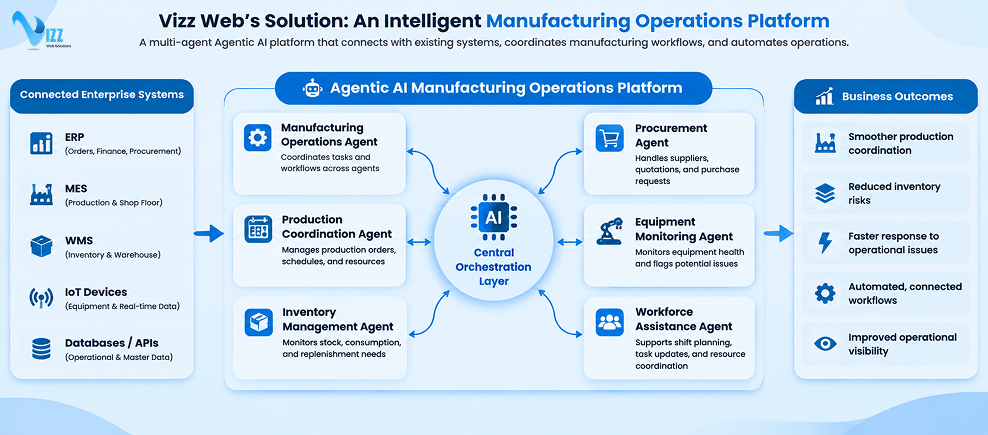
Vizz Web Solutions can address these challenges through a customized AI-powered manufacturing operations platform built around specialized autonomous agents. Each agent manages a particular operational responsibility while communicating with other agents through a central orchestration layer. Instead of replacing existing manufacturing software, the platform connects with authorized systems and uses their information to coordinate workflows.
Key AI Agents for Manufacturing Operations
A well-designed Agentic AI platform uses specialized AI agents to manage different manufacturing functions while working together through a central orchestration system. Each agent handles specific operational tasks, accesses relevant business systems, and coordinates with other agents to streamline workflows and improve overall manufacturing efficiency.
- Manufacturing Operations Agent: Acts as a central operational assistant, retrieving information from connected systems, monitoring workflow progress, and coordinating tasks between specialized agents.
- Production Coordination Agent: Reviews production orders, schedules, available resources, and operational requirements. It identifies scheduling conflicts and helps coordinate approved production adjustments.
- Inventory Management Agent: Monitors stock levels, material consumption, warehouse records, and replenishment requirements. It can identify potential shortages and prepare purchase requests.
- Procurement Agent: Coordinates supplier information, quotations, purchase orders, and procurement documentation. It can automate administrative tasks while maintaining human approval for purchasing decisions.
- Equipment Monitoring Agent: Retrieves equipment information, maintenance records, and operational alerts to identify potential issues and notify maintenance teams.
- Workforce Assistance Agent: Helps employees access operational instructions, production information, equipment documentation, and relevant business records through conversational interfaces.
- Reporting and Analytics Agent: Collects information from connected systems and generates operational reports covering production progress, inventory, procurement, equipment status, and performance indicators.
Together, these manufacturing AI agents create a connected environment where different operational functions can coordinate tasks rather than operate as isolated automation tools.
3. How Agentic AI Automates Manufacturing Workflows
The platform follows a structured process to convert operational requirements into coordinated actions.
Step 1 – Collect Operational Data: AI agents retrieve relevant information from ERP, MES, warehouse management systems, IoT platforms, databases, and other connected applications.
Step 2 – Identify Operational Requirements: Agents analyze production information, inventory records, equipment alerts, and business instructions to identify tasks requiring attention.
Step 3 – Plan and Assign Tasks: The orchestration layer determines which specialized agents, tools, and systems are required to complete the workflow.
Step 4 – Execute Authorized Actions: Agents interact with approved APIs and applications to update records, prepare purchase requests, notify employees, and coordinate operational tasks.
Step 5 – Verify and Report Results: Agents check task completion, identify errors, and escalate exceptions or sensitive decisions to the appropriate employees.
Example: Coordinating a Manufacturing Production Order
Consider a manufacturing facility receiving an updated production order with a shorter delivery deadline. The production coordination agent reviews the revised schedule and checks available resources. The inventory agent verifies whether the required raw materials are available. If additional materials are needed, the procurement agent prepares a purchase request and sends it through the appropriate approval process.
Meanwhile, the equipment monitoring agent checks machine availability, and the reporting agent updates operational information. This coordinated workflow helps employees manage production changes without manually collecting information from multiple departments.
4. Key Manufacturing Operations That Can Be Automated
Agentic AI for manufacturing operations can support several interconnected business processes.
| Operational Area | Agentic AI Application |
|---|---|
| Production Management | Production scheduling, task coordination, and workflow updates |
| Inventory Management | Stock monitoring, replenishment alerts, and material tracking |
| Procurement | Supplier communication and purchase request preparation |
| Equipment Monitoring | Operational alerts and maintenance coordination |
| Workforce Assistance | Access to instructions, records, and production information |
| Order Management | Production order tracking and status updates |
| Supply Chain Coordination | Supplier updates and delivery exception management |
| Operational Reporting | Automated reports and performance summaries |
These applications support AI workflow automation in manufacturing by reducing repetitive coordination and connecting operational information across business systems.
5. Technology Architecture and Enterprise Integration
Effective AI integration in manufacturing requires a reliable architecture that connects AI models with existing business infrastructure. Vizz Web Solutions can develop manufacturing operations platforms using:
- AI Models:OpenAI, Anthropic, and other suitable large language models.
- Agent Frameworks:LangGraph, LangChain, CrewAI, and OpenAI Agents SDK.
- Programming Technologies:Python, Node.js, React, and other suitable technologies.
- Data Infrastructure:PostgreSQL, MySQL, MongoDB, Elasticsearch, and vector databases.
- AI Architecture:Multi-agent orchestration, Retrieval-Augmented Generation (RAG), memory management, and tool calling.
- Enterprise Integrations:ERP, MES, CRM, warehouse management systems, APIs, and IoT platforms.
- Cloud Infrastructure:AWS and other suitable cloud or hybrid environments.
Security and operational control are essential. Solutions should include role-based permissions, encrypted communication, audit logs, workflow validation, and human approval for sensitive actions. AI agents should not independently override machinery safety controls or execute high-risk industrial operations without appropriate authorization.
6. Expected Business Benefits
Implementing Agentic AI for manufacturing operations can help businesses improve coordination across departments and connected applications. Potential benefits include:
- Improved Operational Efficiency:Reduce repetitive administrative and coordination tasks.
- Better Production Visibility:Access relevant operational information through connected AI agents.
- Faster Workflow Execution:Coordinate tasks across production, inventory, and procurement.
- Improved Inventory Coordination:Identify material shortages and prepare replenishment requests.
- Reduced Communication Gaps:Connect employees and departments through intelligent workflows.
- Scalable Automation:Introduce additional AI agents as manufacturing requirements evolve.
Actual results depend on implementation quality, system integration, data availability, and the complexity of existing workflows.
Implement Manufacturing Operations Automation With Vizz Web Solutions
Vizz Web Solutions combines AI development, software engineering, and enterprise system integration to build custom manufacturing automation solutions. With 14+ years of software development experience and more than 1,200 software services delivered, Vizz Web helps manufacturers connect production management, inventory, procurement, equipment monitoring, and workforce operations through Agentic AI.
From intelligent production coordination and automated procurement workflows to multi-agent manufacturing operations platforms, Vizz Web develops scalable solutions tailored to existing business processes, technology infrastructure, and long-term operational requirements.
Conclusion
Agentic AI for manufacturing operations provides an opportunity to connect traditionally separate business processes through intelligent, coordinated workflows. By combining specialized AI agents with existing enterprise applications, manufacturers can automate repetitive tasks, improve operational visibility, and support more informed decisions.
Vizz Web Solutions helps manufacturing businesses explore and implement custom Agentic AI solutions designed around their operational challenges, integration requirements, and automation objectives.