


Manufacturing production schedules must account for customer demand, machine availability, workforce capacity, raw material inventory, production priorities, and delivery deadlines. When any of these factors change, manufacturers may need to revise schedules quickly to prevent bottlenecks, production delays, and resource conflicts. Agentic AI for production scheduling in manufacturing introduces a more adaptive approach, allowing AI agents to analyze changing operational conditions, evaluate scheduling constraints, coordinate resources, and recommend or execute authorized adjustments.
Vizz Web Solutions develops custom Agentic AI solutions that connect intelligent agents with manufacturing systems, production data, and enterprise applications. This case study explores how Vizz Web can help manufacturers automate production planning, improve scheduling decisions, and respond more effectively to operational disruptions.
Case Study Profile & Scope
Industry: Manufacturing and Industrial Operations
Market and Scope: USA, North America, Europe, and Global
Operations: Production planning, scheduling, resource allocation, capacity management, order prioritization, material availability, workforce coordination, and production monitoring.
Technology Environment: ERP platforms, Manufacturing Execution Systems (MES), production planning software, inventory databases, machine monitoring systems, APIs, and AI models.
Solution: Custom Agentic AI Production Scheduling Platform.
Objective: Improve scheduling flexibility, resource utilization, production coordination, and operational decision-making.
Case study approach: This is a solution-focused enterprise case study illustrating how Vizz Web Solutions can design and implement Agentic AI solutions for manufacturing production scheduling. It does not represent a specific completed client deployment or independently verified performance results.
1. The Challenge: Managing Dynamic Manufacturing Schedules
Manufacturers must coordinate multiple production orders while balancing machine capacity, workforce availability, material requirements, and delivery deadlines. Even a small disruption can affect several downstream production activities. When schedules rely on spreadsheets, disconnected systems, or static planning tools, production planners may spend significant time identifying conflicts and manually adjusting workflows.
Common challenges include:
- Changing Customer Orders: New orders, revised quantities, and urgent delivery requests affect existing production plans.
- Machine Capacity Constraints: Equipment availability, maintenance, and production bottlenecks limit scheduling flexibility.
- Material Shortages: Missing raw materials or delayed supplier deliveries disrupt planned production.
- Workforce Availability: Shift changes, employee availability, and skill requirements affect resource allocation.
- Production Bottlenecks: Inefficient sequencing creates idle time, congestion, or delays between production stages.
- Manual Schedule Adjustments: Planners repeatedly review information from multiple systems to update schedules.
- Limited Real-Time Visibility: Production floor changes may not immediately reflect in planning systems.
These challenges create an opportunity for AI-powered production scheduling that continuously evaluates operational conditions and supports more responsive planning.
2. Vizz Web’s Solution: An Agentic AI Production Scheduling Platform
Vizz Web Solutions can address these challenges through a custom AI production scheduling platform powered by specialized agents and a central orchestration layer. The platform connects production planning systems, ERP, MES, inventory, equipment monitoring, and workforce information. Each agent evaluates a specific scheduling factor and communicates relevant findings to other agents.
Key AI Agents for Production Scheduling
A coordinated production scheduling platform uses specialized agents to evaluate different production requirements and help manufacturers manage changing schedules. Each agent works with operational data and follows defined business constraints and permissions.
- Production Planning Agent: Analyzes production orders, delivery deadlines, priorities, and available resources to create or update production plans.
- Capacity Planning Agent: Evaluates machine capacity, production workloads, and resource availability to identify scheduling conflicts.
- Inventory and Material Agent: Checks raw materials and component availability to determine whether production orders can proceed as planned.
- Equipment Availability Agent: Monitors machine status, downtime, and maintenance schedules to identify potential production disruptions.
- Workforce Scheduling Agent: Evaluates shift availability, workforce capacity, and skill requirements to support resource allocation.
- Scheduling Optimization Agent: Evaluates alternative production sequences based on deadlines, priorities, capacity, and operational constraints.
- Production Monitoring Agent: Tracks production progress, identifies deviations from planned schedules, and communicates changes to relevant agents and employees.
3. How Agentic AI Automates Production Scheduling
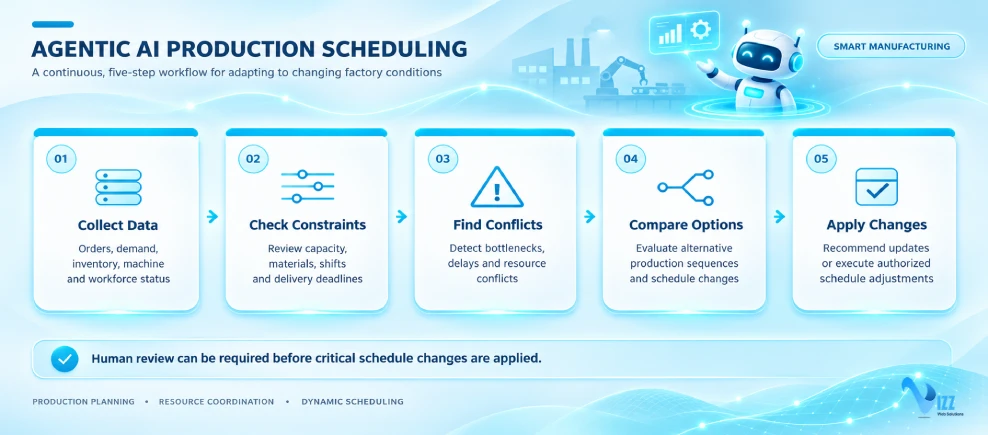
The platform uses a continuous scheduling workflow to respond to changes in manufacturing operations.
Step 1 – Collect Production Information: AI agents retrieve production orders, demand forecasts, inventory levels, equipment status, workforce availability, and scheduling requirements.
Step 2 – Evaluate Scheduling Constraints: Agents assess machine capacity, material availability, workforce requirements, production priorities, and delivery deadlines.
Step 3 – Identify Scheduling Conflicts: The system identifies bottlenecks, delayed orders, resource conflicts, and tasks that may require rescheduling.
Step 4 – Generate and Evaluate Alternatives: The scheduling optimization agent evaluates possible production sequences and adjustments based on defined business priorities.
Step 5 – Execute or Recommend Adjustments: The platform presents proposed schedule changes or updates authorized planning systems. Critical adjustments can require approval from production planners.
Example: Responding to a Machine Breakdown
Suppose a machine used for several production orders suddenly becomes unavailable. The equipment availability agent reports the disruption to the production planning agent, which evaluates affected orders and their deadlines.
The capacity planning agent checks whether other machines can handle the workload, while the inventory agent verifies material availability. The scheduling optimization agent evaluates alternative production sequences and prepares an updated schedule. Production managers can review and approve the proposed adjustments without manually rebuilding the entire production plan.
4. Manufacturing Scheduling Processes That Can Benefit from Agentic AI
Agentic AI can connect production requirements with real-time operational information to improve scheduling flexibility, resource coordination, and production planning.
5. Technology Architecture and Manufacturing Integration
Effective AI production scheduling requires integration with existing planning and manufacturing systems. Vizz Web Solutions can develop custom platforms using AI models, Python, Node.js, production databases, optimization algorithms, and multi-agent frameworks such as LangGraph, LangChain, CrewAI, and OpenAI Agents SDK. The platform can integrate with ERP, MES, inventory management, machine monitoring, and production planning systems through APIs and supported connectors.
Autonomous AI agents can handle information analysis, workflow coordination, and scheduling interactions, while mathematical optimization algorithms evaluate complex scheduling problems involving machine capacity, sequencing, deadlines, and resource constraints. This combination allows AI to support reasoning and coordination while structured optimization methods handle precise scheduling calculations.
6. Expected Business Benefits
Implementing Agentic AI for manufacturing production scheduling can help businesses improve planning flexibility and coordinate resources more effectively. Potential benefits include:
- Improved Schedule Adaptability: Respond to changing orders, equipment availability, and material requirements.
- Better Resource Utilization: Coordinate machine capacity, workforce, and production workloads.
- Reduced Scheduling Workload: Automate repetitive schedule reviews and adjustment workflows.
- Improved Production Visibility: Track planned activities, production progress, and operational disruptions.
- Better Order Coordination: Evaluate delivery priorities and production requirements together.
- More Informed Decisions: Provide planners with scheduling alternatives based on current operational information.
Actual results depend on data quality, integration capabilities, scheduling complexity, and implementation design.
Implement AI Production Scheduling With Vizz Web Solutions
Vizz Web Solutions combines AI development, software engineering, and enterprise system integration to build custom production scheduling solutions. With 17+ years of software development experience and more than 1,200 software services delivered, Vizz Web helps manufacturers connect production planning, inventory, equipment, workforce, and scheduling workflows through Agentic AI.
From intelligent production planning and dynamic schedule adjustments to capacity optimization and multi-agent manufacturing platforms, Vizz Web develops scalable solutions tailored to existing industrial processes, technology infrastructure, and operational requirements.
Conclusion
Agentic AI for production scheduling in manufacturing provides an opportunity to move beyond static production plans toward more adaptive and connected scheduling workflows. By combining AI agents, optimization algorithms, and enterprise system integration, manufacturers can respond to changing demand, equipment disruptions, material shortages, and resource constraints with greater flexibility.
Vizz Web Solutions helps manufacturers design and implement custom Agentic AI solutions that support intelligent production planning, dynamic scheduling, resource coordination, and manufacturing automation.